


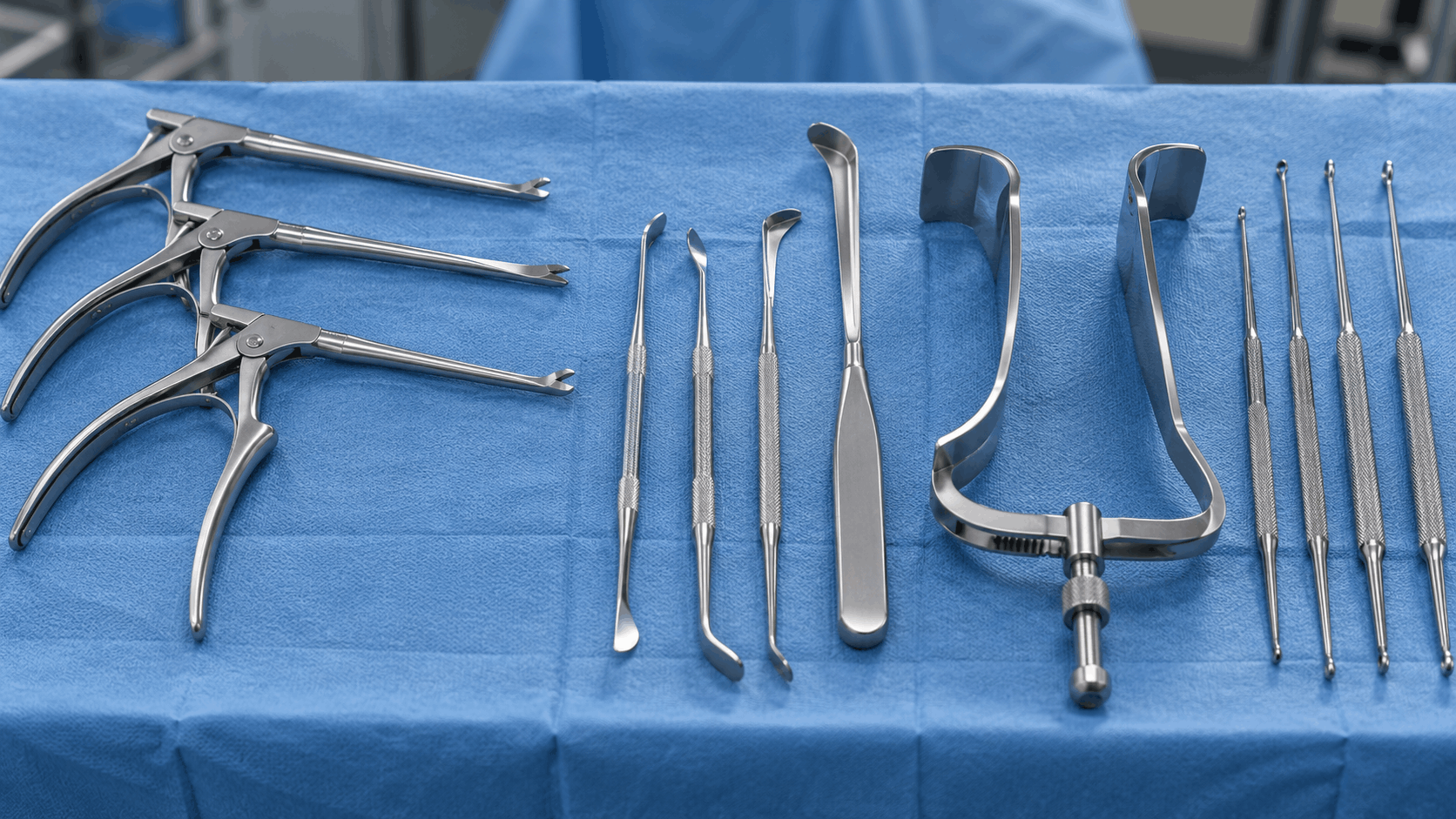
Spine surgery demands precision at the millimeter level. A few millimeters separate a safe decompression from damage to the spinal cord or a nerve root. That is why spinal surgery instruments are among the most specialized and carefully engineered tools in the operating room.
Whether you are a neurosurgeon, an orthopedic spine surgeon, a scrub nurse, a sterile processing technician or a hospital procurement manager, understanding spinal surgery instruments helps you improve outcomes, reduce operating time and make smarter purchasing decisions.
This complete guide, brought to you by OrthoGear Surgical, covers the main types of spinal surgery instruments, how each is used, the materials they are made from, how to care for them and what to look for when buying.
What Are Spinal Surgery Instruments?
Spinal surgery instruments are precision tools designed for procedures on the vertebrae, intervertebral discs, spinal cord, nerve roots and surrounding soft tissues. They are used to:
- Expose the spine safely through a surgical corridor
- Remove bone, disc material or tumors that compress neural structures
- Place and secure implants such as screws, rods, plates and cages
- Restore alignment and stability to the spinal column
- Protect delicate neural and vascular structures during surgery
Spinal instruments differ from general orthopedic instruments because they are generally longer, finer and more angled. They are built to work in narrow surgical fields close to critical neural tissue.
Why Quality Spinal Surgery Instruments Matter
- Patient safety: Precisely machined tips and consistent cutting edges reduce the risk of dural tears and nerve injury.
- Surgical efficiency: Well-balanced, ergonomic instruments reduce surgeon fatigue and help speed up procedures.
- Implant accuracy: Pedicle screw and cage instrumentation must match the implant system exactly to ensure proper fit and fixation.
- Infection control: Smooth finishes and well-designed joints make cleaning and sterilization more effective.
- Cost over time: High-grade instruments hold their edge longer and cost less per use than cheap alternatives.
Main Categories of Spinal Surgery Instruments
Spinal surgery instruments are usually grouped by function. Below are the categories you will find in a standard spine set.
1. Exposure and Retraction Instruments
Every spine procedure begins with creating a clear surgical field. Surgical retractors hold muscle, skin and soft tissue out of the way so the surgeon can see and work.
- Taylor spinal retractor: A long, blade-style retractor that holds soft tissue and retracts deep structures during lumbar and thoracic procedures.
- Gelpi retractor: A self-retaining retractor with pointed tips, useful for laminectomy and posterior approaches.
- Weitlaner retractor: A self-retaining retractor used for superficial to moderately deep exposures.
- Cobb periosteal elevator: Strips muscle and periosteum off the lamina and spinous processes to expose bone.
- Penfield dissectors (Nos. 1 to 4): Used to separate dura from bone and to dissect delicate tissue planes.
- Cervical retractors (such as Cloward and Caspar systems): Used in anterior cervical approaches to hold the trachea, esophagus and soft tissue aside.
- Deaver and Hohmann-type retractors: Used in anterior and lateral approaches to hold organs and vessels away.
- Minimally invasive tubular retractors: Expandable or fixed tubes that create a small working channel through muscle with less tissue disruption.
2. Bone Cutting and Decompression Instruments
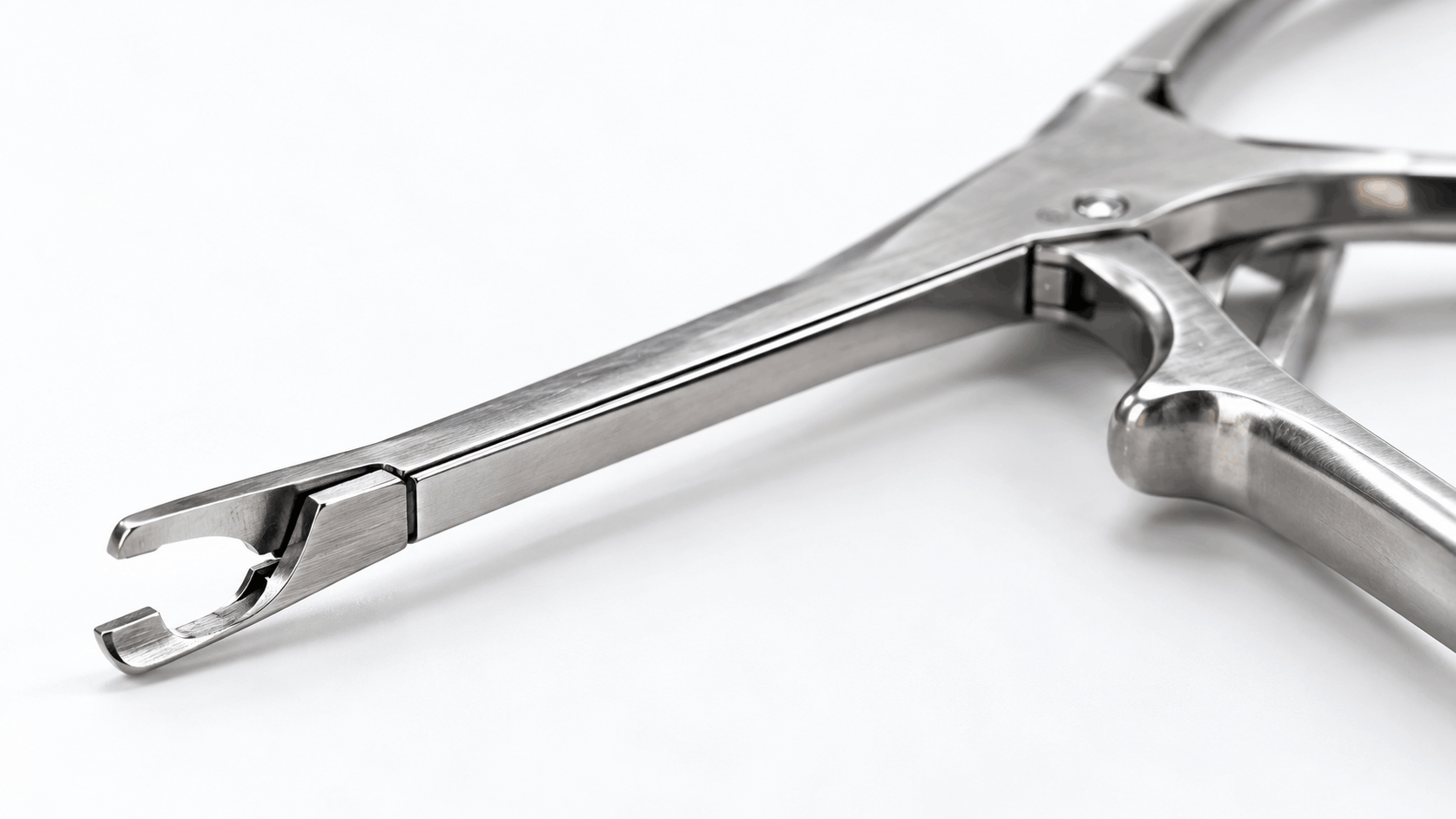
Many spinal procedures involve removing bone or disc to relieve pressure on the spinal cord or nerve roots. This is called decompression.
- Kerrison rongeurs: Among the most recognized spinal surgery instruments. The thin footplate slides under bone, letting the surgeon bite away lamina, ligamentum flavum or osteophytes with a controlled punching action. They come in different bite sizes and angles (up-biting and down-biting).
- Leksell rongeur: A strong, general-purpose bone-biting instrument used to remove spinous processes and bone fragments.
- Lempert rongeur: A double-action rongeur offering good leverage for cutting bone.
- Spinal curettes (straight, angled, ring): Used to scrape disc material, cartilage and endplate tissue.
- Pituitary rongeurs: Used to remove disc fragments during discectomy.
- Osteotomes and chisels: Used to cut bone cleanly in deformity correction or when removing bony segments.
- High-speed drills and burrs: Power instruments that shape and thin bone. Diamond burrs are often used near the dura for safer bone removal.
- Ultrasonic bone scalpels: Cut bone while sparing soft tissue.
3. Pedicle Screw Placement Instruments
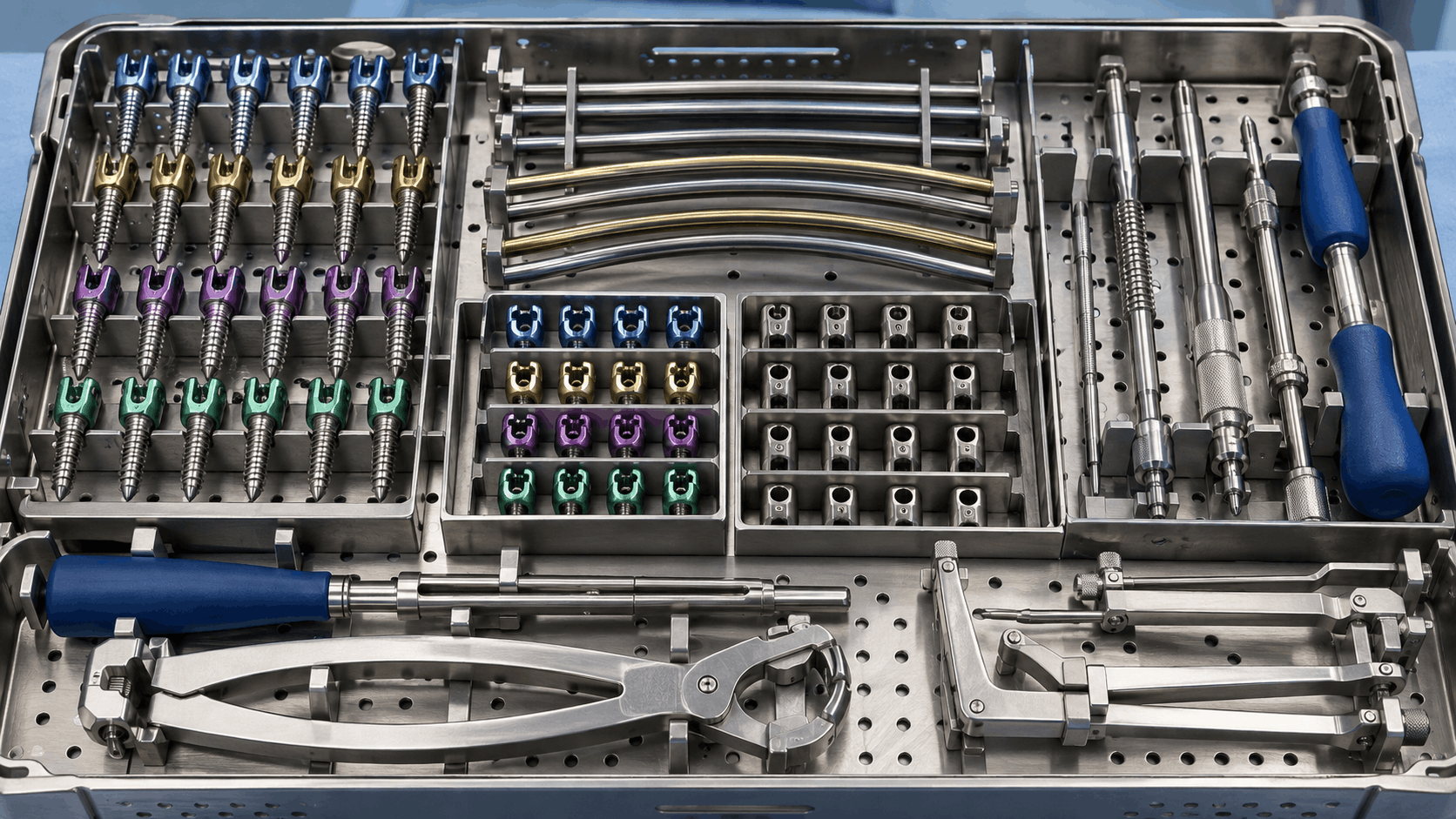
Pedicle screw fixation is a cornerstone of modern spinal fusion and deformity surgery. The right instruments make screw placement safer and more accurate.
- Awl or pedicle starter: Creates the entry point in the cortical bone.
- Pedicle probe (pedicle finder): Gently advances through cancellous bone to form a pilot channel along the pedicle.
- Ball-tip feeler (sounding probe): Checks that all four walls of the pedicle channel are intact before screw insertion.
- Taps: Cut threads in the bone channel, matched to the screw diameter.
- Screwdrivers and inserters: Drive the screw into the vertebra, available in fixed and ratcheting designs.
- Rod holders and rod benders: Position the connecting rod and contour it to the patient’s alignment.
- Rod persuaders and reducers: Seat the rod fully into the screw heads when the spine is not perfectly aligned.
- Compressors and distractors: Apply controlled force between screws to compress or open segments.
- Counter-torque and torque-limiting wrenches: Make sure set screws are tightened to the recommended torque without over-stressing the construct.
4. Interbody Fusion Instruments
Interbody fusion procedures such as ALIF, PLIF, TLIF, XLIF/LLIF and ACDF involve removing the damaged disc and placing a cage or graft in the disc space.
- Disc space distractors and spreaders: Restore disc height and open the space.
- Rasps and shavers: Prepare the endplates for fusion by removing cartilage.
- Trial implants (trials): Allow the surgeon to test cage sizes before placing the final implant.
- Cage inserters and impactors: Hold and gently place the cage into position.
- Graft funnels and packers: Deliver bone graft material into the cage and disc space.
- Disc curettes and pituitary rongeurs: Clear disc material.
5. Cervical Spine Instruments
The cervical spine is delicate and surrounded by critical structures, so cervical spine instruments are smaller and finer.
- Caspar pin distractors: Distract the disc space using pins placed in the vertebral bodies.
- Smith-Robinson-style instruments: Used in anterior cervical discectomy and fusion.
- Fine-angled curettes and micro-Kerrison rongeurs: Remove disc and osteophytes close to the spinal cord.
- Cervical plate holders, drill guides and screwdrivers: Used to place anterior cervical plates.
- Halo and tong traction devices: Used for cervical stabilization and traction.
6. Minimally Invasive Spine Surgery (MIS) Instruments
Minimally invasive spine surgery uses smaller incisions and less muscle disruption, which often means less blood loss and faster early recovery for suitable patients. It depends on specialized instruments.
- Serial dilators: Gradually widen a pathway through muscle.
- Tubular and expandable retractors: Hold the working channel open.
- Jamshidi needles and K-wires: Used for percutaneous pedicle screw placement.
- Cannulated screwdrivers and taps: Work over guide wires.
- Long-handled, bayoneted instruments: Let the surgeon work through a narrow tube while keeping the hands out of the line of sight.
- Endoscopic spine instruments: Used with endoscopes for discectomy and decompression through very small portals.
- Percutaneous rod insertion systems: Place rods beneath the muscle without large incisions.
7. Vertebral Augmentation Instruments
For painful vertebral compression fractures, vertebroplasty and kyphoplasty use specialized instruments, including bone access needles, working cannulas, balloon tamps, bone cement mixers and cement delivery systems.
8. Navigation, Imaging and Neuromonitoring Tools
Technology has become an essential part of spinal surgery instrumentation:
- Intraoperative navigation systems: Provide real-time 3D guidance for instrument and implant placement.
- Robotic-assisted platforms: Help plan and guide trajectories for pedicle screws.
- C-arm fluoroscopy and intraoperative CT: Confirm level and implant position.
- Neuromonitoring (SSEP, MEP, EMG): Warns the team of possible nerve irritation or injury during surgery.
- Stimulating probes: Test whether a screw channel has breached the pedicle wall.
9. Suturing, Hemostasis and Closure Instruments
Standard surgical tools remain essential in spine sets, including needle holders, Adson forceps, bayonet forceps, bipolar forceps, Metzenbaum scissors, hemostats, Frazier suction tips and towel clamps. Bipolar forceps and fine suction tips are especially important for controlling bleeding around the dura and epidural veins.
Common Spinal Procedures and the Instruments They Use
| Procedure | Key Instruments Used |
|---|---|
| Laminectomy | Cobb elevators, Kerrison rongeurs, Penfield dissectors, Taylor retractor, drills |
| Discectomy / Microdiscectomy | Tubular retractor, Kerrison rongeur, pituitary rongeur, curettes, nerve hooks |
| Lumbar fusion (TLIF/PLIF) | Pedicle screw set, interbody trials, cage inserters, rod benders, distractors |
| ACDF (cervical fusion) | Caspar distractor, cervical curettes, plate holders, drill guides |
| Scoliosis / deformity correction | Osteotomes, rod benders, derotation tools, reducers, compressors |
| Kyphoplasty / Vertebroplasty | Access needles, balloon tamps, cement delivery system |
| Spinal tumor resection | Ultrasonic aspirators, drills, curettes, neuromonitoring probes |
Materials Used in Spinal Surgery Instruments
The material determines durability, corrosion resistance and sharpness.
Instruments
- Surgical-grade stainless steel: The most common material. Grades such as 410 and 420 are used for cutting instruments because they can be hardened, while 304 and 316 are used where corrosion resistance matters most. Quality instruments are heat-treated, passivated and polished.
- Titanium: Lightweight, strong and corrosion resistant. Some retractors and handles are made of titanium to reduce weight and fatigue.
- Tungsten carbide inserts: Used on cutting edges and needle holder jaws for long-lasting sharpness.
- Radiolucent materials (carbon fiber, PEEK): Used for retractor blades or frames that should not block fluoroscopic images.
Implants
- Titanium alloys: Widely used for screws, rods and cages because of strength and biocompatibility.
- PEEK (polyether ether ketone): Common for interbody cages because its stiffness is closer to bone and it is radiolucent.
- Cobalt-chrome: Used in some rods for stiffness.
How to Choose the Right Spinal Surgery Instruments
- Match the procedure mix: Choose sets based on the procedures your team actually performs, such as lumbar, cervical or MIS.
- Check material and finish: Look for medical-grade stainless steel with a smooth, non-reflective finish that reduces glare under operating lights.
- Verify precision and tolerances: Rongeur tips should align perfectly and ratchets should hold securely.
- Consider ergonomics: Handle shape, weight and balance matter during long cases.
- Compatibility with implant systems: Screwdrivers, taps and inserters must match the implant manufacturer’s specifications.
- Regulatory compliance: Look for ISO 13485 quality management certification, CE marking and, for the U.S. market, FDA registration as applicable.
- Sterilization compatibility: Confirm the instrument tolerates autoclave cycles and the cleaning chemicals you use.
- Warranty and repair support: A reputable supplier offers repair, sharpening and replacement services.
- Reliable supplier reputation: Ask for product samples, certifications and references before bulk purchase. Learn about OrthoGear Surgical.
- Total cost of ownership: The cheapest instrument is rarely the most economical over several years of use.
Cleaning, Sterilization and Maintenance of Spinal Instruments

Spinal instruments have lumens, hinges and fine tips where debris easily hides. Proper reprocessing protects patients and extends instrument life.
Step-by-Step Care Process
- Point-of-use cleaning: Wipe gross debris right after use and keep instruments moist with sterile water or an approved pre-cleaning solution. Never soak in saline, because it can cause corrosion.
- Disassembly: Open hinged instruments and take apart multi-part instruments per the manufacturer’s instructions.
- Manual cleaning: Use soft brushes, including lumen brushes for cannulated instruments. Avoid abrasive pads.
- Ultrasonic cleaning: Helps dislodge debris from joints, serrations and lumens.
- Automated washer-disinfector: Provides thorough, validated cleaning.
- Rinse and dry: Use purified water and dry completely to prevent spotting and rust.
- Inspection: Check tips, edges, ratchets and hinges under magnification. Remove damaged or dull items.
- Lubrication: Apply water-soluble instrument milk to hinges and moving parts.
- Sterilization: Steam autoclave is the standard method. Follow the manufacturer’s validated parameters.
- Storage: Keep in protective trays, and store sterile sets in a clean, dry area.
Maintenance Tips
- Send Kerrison rongeurs and other cutting instruments for sharpening on a regular schedule.
- Never use instruments for purposes other than their design.
- Keep delicate micro-instruments separate from heavy ones in trays.
- Track instrument use and service history for quality control.
Latest Trends in Spinal Surgery Instrumentation
- Robotics and navigation: Growing adoption to improve screw accuracy and reduce radiation exposure for the team.
- Minimally invasive and endoscopic techniques: Expanding as instrument design improves.
- 3D-printed implants and patient-specific instruments: Allow custom-fit cages and guides.
- Enabling technologies: Bone graft substitutes and better fusion techniques.
- Single-use and sterile-packed instruments: Reduce reprocessing needs and cross-contamination risk.
- Augmented reality visualization: Early-stage tools that overlay imaging data in the surgeon’s view.
- Better ergonomics: Lighter, balanced instruments to reduce surgeon fatigue.
Common Mistakes When Buying or Using Spinal Instruments
- Choosing instruments solely on price
- Buying sets that do not match the surgeon’s technique or implant system
- Skipping regular inspection and sharpening
- Using damaged or misaligned rongeurs
- Skipping validated sterilization steps
- Not training OR and sterile processing staff on new instrument sets
Want to learn more? Read the guidelines and education resources from the North American Spine Society (NASS), AO Spine and research on PubMed.
Frequently Asked Questions (FAQs)
What are spinal surgery instruments?
Spinal surgery instruments are specialized tools used to access, decompress, stabilize and repair the spine. They include retractors, rongeurs, curettes, pedicle screw systems, interbody cage instruments and navigation or neuromonitoring tools.
What is a Kerrison rongeur used for?
A Kerrison rongeur removes thin layers of bone, ligament or osteophytes, usually near the spinal cord or nerve roots. Its low-profile footplate allows controlled bone removal during laminectomy and foraminotomy.
What instruments are used in a laminectomy?
Typical laminectomy instruments include Cobb elevators, Penfield dissectors, Taylor or Gelpi retractors, Kerrison rongeurs, curettes, high-speed drills and bipolar forceps.
What is the difference between spinal and general orthopedic instruments?
Spinal instruments are generally longer, finer and more angled to reach deep, narrow fields near neural structures. General orthopedic instruments are often larger and built for long bones and joints.
What materials are spinal surgery instruments made from?
Most are made from surgical-grade stainless steel. Some include titanium parts, tungsten carbide inserts for cutting edges, or radiolucent materials such as carbon fiber.
How often should spinal instruments be sharpened or replaced?
There is no fixed schedule. It depends on use frequency, instrument type and condition. Cutting instruments should be inspected after every cycle and sharpened or replaced when dull, misaligned or damaged.
How are spinal surgery instruments sterilized?
Most are steam sterilized in an autoclave after thorough manual and automated cleaning. Always follow the manufacturer’s instructions for use (IFU).
What is a pedicle screw instrument set?
It is a collection of tools used to place pedicle screws and rods, including awls, probes, taps, screwdrivers, rod benders, persuaders, compressors and distractors.
What should I look for in a spinal instruments supplier?
Look for ISO 13485 certification, CE or FDA compliance where applicable, material traceability, strong quality control, warranty coverage, repair services and positive references from hospitals or surgeons.
Are minimally invasive spine instruments different from open surgery instruments?
Yes. They are usually longer and narrower, and are used through tubular retractors or endoscopic channels to work in small spaces with less tissue disruption.
Conclusion
Spinal surgery instruments are the foundation of safe, accurate and efficient spine surgery. From simple retractors to advanced navigation and robotic systems, every instrument has a clear purpose in protecting the patient and helping the surgeon achieve the best result.
By understanding the types of spinal surgery instruments, the materials they are made from and how to care for them, surgeons, OR teams and procurement professionals can build reliable instrument sets, extend their service life and support better patient outcomes. Always prioritize quality, compatibility, regulatory compliance and a trusted supplier relationship.
Looking for high-quality spinal surgery instruments? Contact OrthoGear Surgical for catalogs, custom sets and bulk pricing, or visit our homepage to explore the full range.
2 thoughts on “Spinal Surgery Instruments: Types, Uses & Complete Guide for Surgeons”