


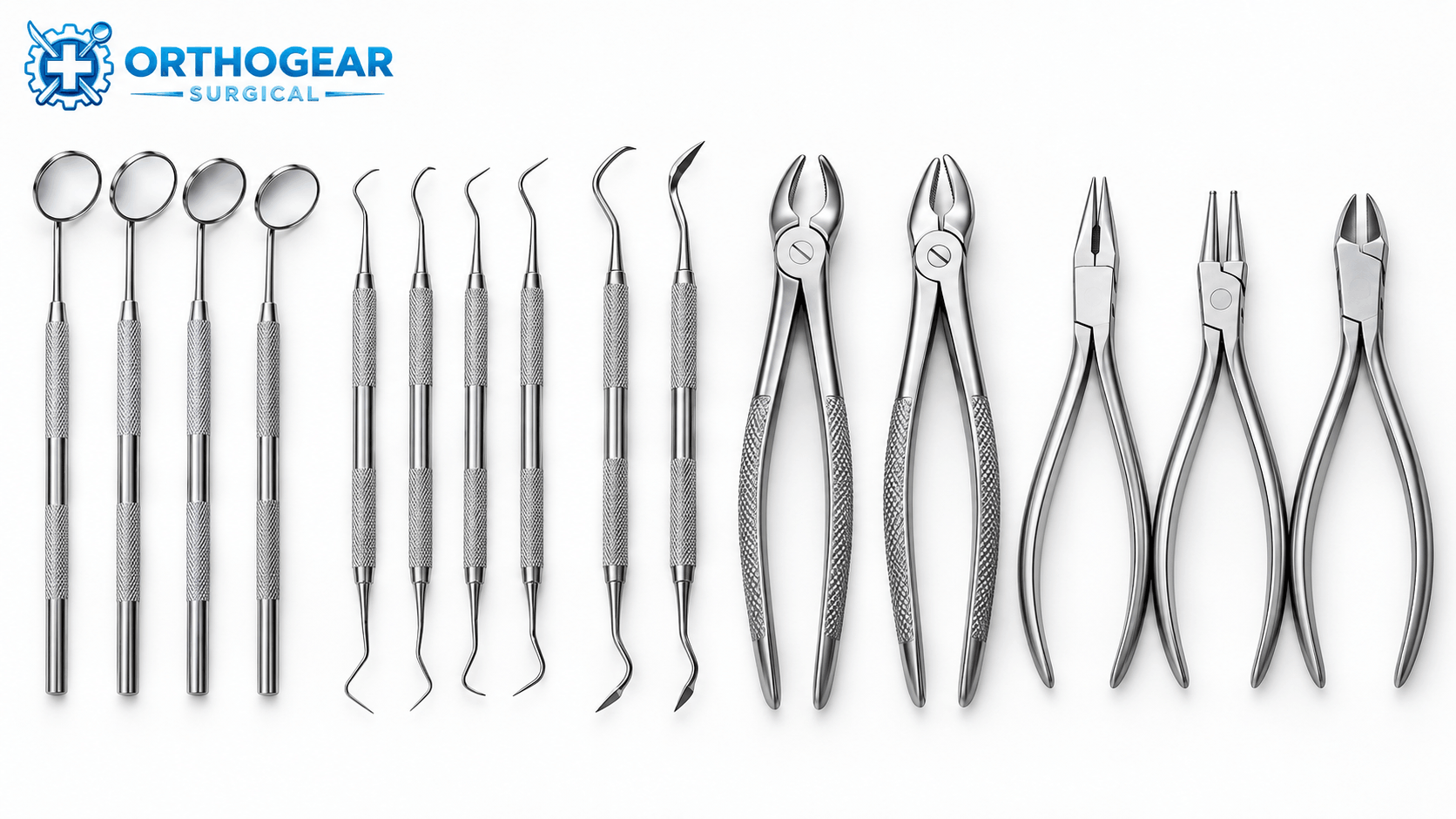
A mirror that fogs, a scaler that dulls quickly, or forceps that rust after a few autoclave cycles slow down every procedure and frustrate clinicians. For clinic owners, dental distributors, hospital procurement teams and dental schools in the United States and Europe, the best way to control costs without sacrificing quality is to buy wholesale dental instruments directly from a reliable source.
Wholesale buying in these markets is about more than the lowest price. Buyers in the USA must consider FDA requirements, while buyers in the European Union must comply with CE marking under the Medical Device Regulation (MDR). Traceability, labeling, customs and importer responsibilities matter too. A supplier who cannot handle this paperwork can leave a shipment stuck at the border or make your products unsellable.
This guide explains what wholesale dental instruments are, which types to stock, how stainless steel grades affect performance, which certifications each market requires, how to choose a dental instruments supplier, how pricing, MOQ and shipping work, and which mistakes to avoid. If you are ready to source now, you can explore Orthogear Surgical, a dental and surgical instruments manufacturer based in Sialkot, Pakistan, or send a request through our bulk surgical instruments supplier inquiry page.
Table of Contents
- What Are Wholesale Dental Instruments?
- Who Buys Dental Instruments in Bulk?
- Benefits of Buying Dental Instruments Wholesale
- Types of Dental Instruments to Buy in Bulk
- Stainless Steel Dental Instruments: Grades and Quality
- How Quality Instruments Are Manufactured
- USA Requirements: FDA, UDI and Import Basics
- Europe Requirements: MDR, CE Marking and Authorized Representatives
- ISO Standards Every Buyer Should Know
- Dental Instruments Manufacturer vs. Distributor
- How to Choose a Reliable Dental Instruments Supplier
- Pricing, MOQ, Payment and Shipping
- Custom, OEM and Private Label Options
- Inspecting Your Order and Caring for Instruments
- Common Mistakes Buyers Make
- Starter Wholesale List for a New Dental Clinic
- Market Trends
- Why Buy from Orthogear Surgical
- Frequently Asked Questions
- Final Thoughts
What Are Wholesale Dental Instruments?
Wholesale dental instruments are professional dental tools sold in large quantities at a lower price per unit than retail. Instead of ordering one or two pieces from a local supplier, a wholesale buyer orders by the dozen, hundred or carton directly from a manufacturer, exporter or large distributor.
The category includes examination instruments, restorative tools, scalers, orthodontic pliers, endodontic instruments, extraction forceps, elevators, and the accessories used to store and sterilize them. Many buyers also order sterilization pouches, cassettes and trays from the same supplier to simplify purchasing.
How wholesale differs from retail
- Volume: Orders are placed in larger quantities, often with a minimum order quantity (MOQ).
- Unit price: The more you buy, the more you save.
- Source: Purchases often come directly from the factory, without middlemen.
- Customization: Laser marking, private labeling and custom sets are common.
- Documentation: Wholesale transactions include invoices, certificates and export paperwork, which are essential for US and EU customs.
Who Buys Dental Instruments in Bulk?
- New and growing dental clinics: Equipping operatories with wholesale sets costs far less than buying piece by piece.
- DSOs and dental groups: Multi-location practices use the same instruments everywhere for consistent quality.
- Dental resellers: They buy in bulk to sell under their own brand or a private label.
- Hospitals and public tenders: They need certified instruments and consistent batches.
- Dental schools and training institutes: Students need durable, affordable kits.
- Dental NGOs: Their programs need instruments that survive repeated sterilization in demanding conditions.
- Online sellers: Sellers on Amazon, eBay and their own stores compete on price, so reliable supply is critical.
Benefits of Buying Dental Instruments Wholesale
- Lower cost per unit: The manufacturer spreads setup, packing and shipping costs over more pieces, and you benefit from the saving.
- Consistent quality across batches: Ordering a large quantity from one dental instruments manufacturer gives you the same steel quality, finish and dimensions every time.
- Better inventory control: Bulk stock lets you replace worn or lost instruments quickly, so procedures are never delayed.
- Access to customization: Wholesale volume makes custom handles, color coding, laser-etched logos and tailored sets possible.
- Stronger supplier relationships: Repeat customers often receive priority production, better payment terms and faster support.
- Simpler procurement: One reliable supplier for instruments and related supplies means fewer purchase orders and less paperwork.
Types of Dental Instruments to Buy in Bulk
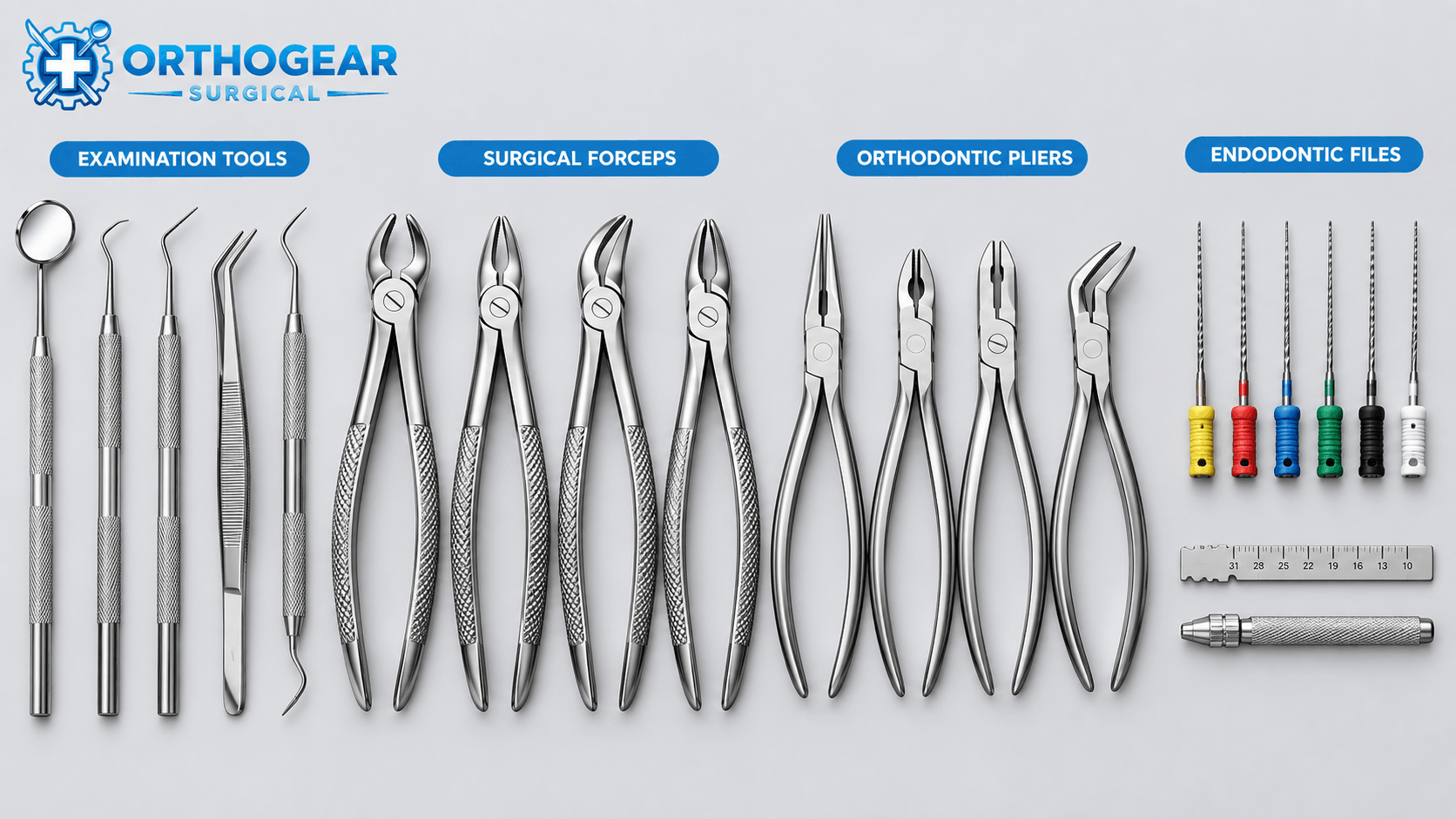
1. Diagnostic and examination instruments
- Mouth mirrors (front-surface and standard) and mirror handles
- Explorers and periodontal probes (Williams, UNC-15, WHO and others)
- Cotton pliers (dental tweezers)
- Examination sets combining a mirror, explorer and tweezer
These are used at every appointment and replaced often, which makes them ideal wholesale products.
2. Restorative instruments
- Amalgam condensers
- Composite placement instruments, often with titanium-nitride coated tips
- Spoon and disc excavators
- Burnishers and carvers
- Cement spatulas
- Matrix retainers and bands
3. Periodontal and hygiene instruments
- Hand scalers (sickle and universal)
- Gracey and universal curettes
- Ultrasonic scaler tips (brand-specific)
- Periodontal probes
Edge retention is critical here, which is why steel quality and heat treatment matter so much.
4. Surgical dental instruments
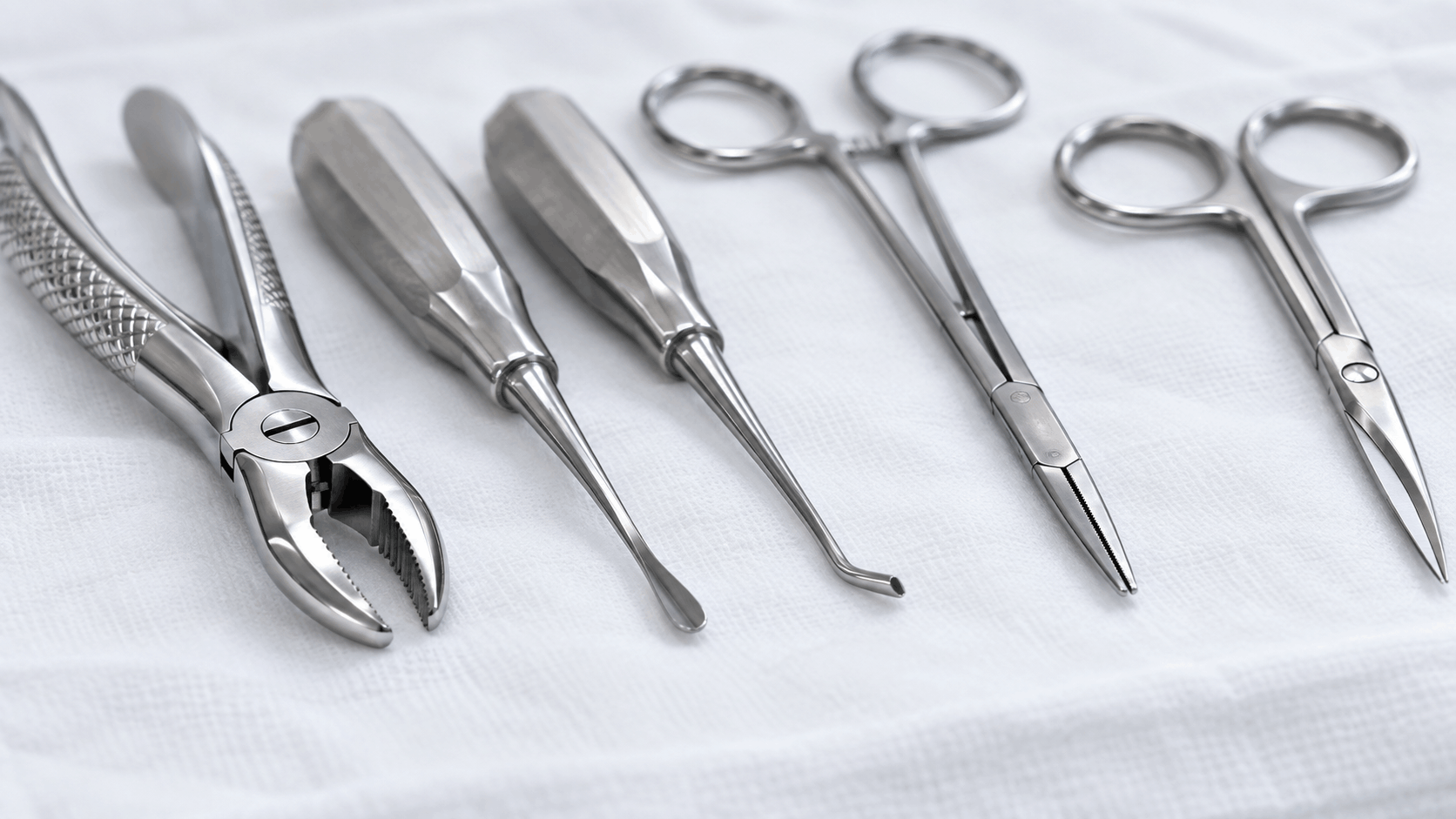
Surgical dental instruments work on tissue and bone, so cleanliness and finish standards are very high.
- Extraction forceps (upper, lower, anterior, molar and pediatric patterns, in both American and English styles)
- Straight, curved and root tip elevators
- Surgical scissors and tissue forceps
- Needle holders
- Periosteal elevators
- Bone curettes and rongeurs
- Retractors such as Minnesota and cheek retractors
- Scalpel handles
US and European clinicians often prefer different forceps patterns. American and English extraction forceps differ in shape and numbering, so confirm the pattern system your customers expect.
5. Orthodontic instruments
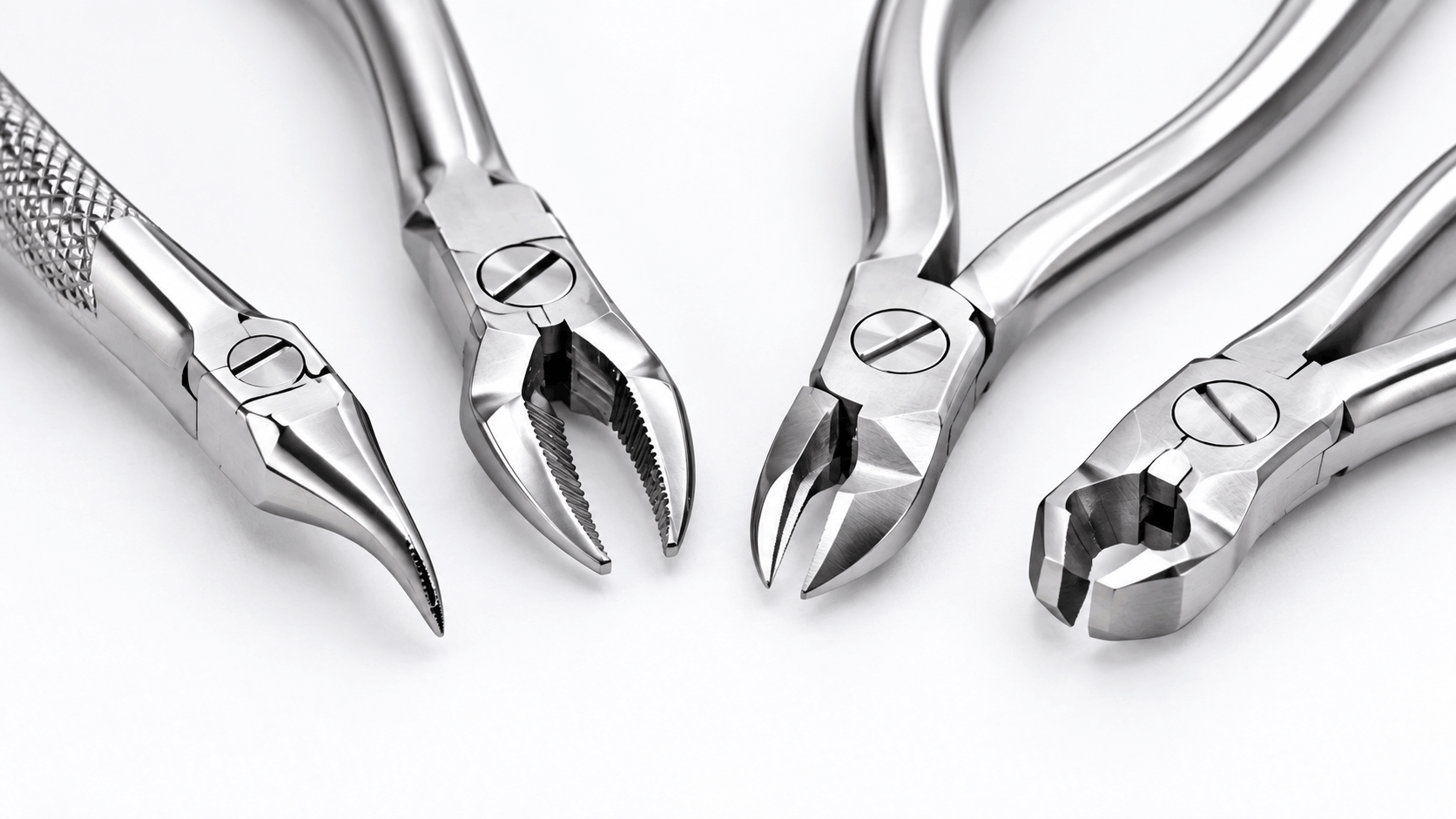
- Pliers such as Adams, three-jaw, bird beak, distal end cutters, ligature cutters and Weingart utility pliers
- Bracket tweezers and holders
- Band pushers and removers
- Ligature directors and wire benders
Precision is essential. Misaligned pliers, or cutting edges that do not meet correctly, make daily work frustrating.
6. Endodontic instruments
- Hand files and reamers
- Spreaders and pluggers
- DG16 root canal explorers
- Rubber dam clamps, frames and forceps
7. Implant and prosthodontic instruments
- Drill kits, drivers and torque wrenches
- Bone graft instruments
- Impression trays
- Wax spatulas and articulating instruments
Implant-related items need tight tolerances, so check quality carefully.
8. Sterilization accessories and storage
- Instrument cassettes and trays
- Sterilization pouches and rolls
- Containers and racks
- Instrument milk and cleaning solutions
Sets vs. individual pieces
Ready-made sets (examination, periodontal, oral surgery) save time and suit new clinics and schools. Individual bulk pieces suit distributors who assemble their own kits.
Stainless Steel Dental Instruments: Grades and Quality
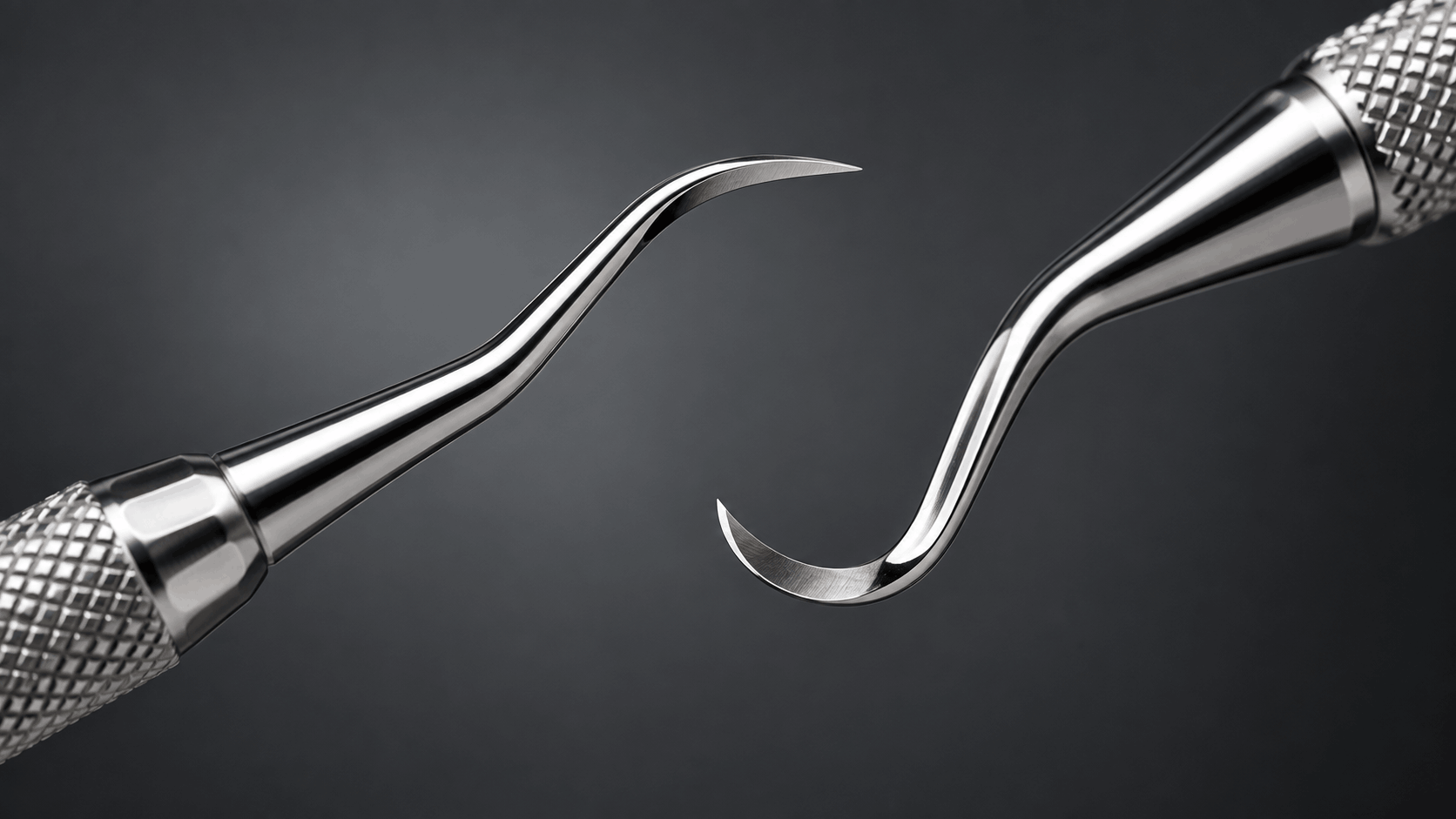
The steel decides how sharp an instrument stays, how well it resists rust, and how many sterilization cycles it survives. Not all stainless steel dental instruments are the same, and low-quality suppliers most often cut corners here.
Why stainless steel?
Instruments must be hard enough to hold an edge, strong enough not to bend or break, and corrosion resistant enough to survive saliva, blood, detergents and steam sterilization. Stainless steel balances these needs better than any alternative.
Common grades
Martensitic (400 series)
- AISI 420 (420A, 420B, 420C): The most widely used grade for scalers, curettes, elevators and surgical scissors. It hardens through heat treatment and holds a sharp edge. Higher-carbon versions are slightly less corrosion resistant.
- AISI 410: Used for parts needing hardness and good corrosion resistance, such as some forceps and clamps.
- AISI 440: Very hard and wear resistant, used for some high-precision cutting instruments.
Austenitic (300 series)
- AISI 304: Excellent corrosion resistance but cannot be hardened by heat treatment. Used for trays, cassettes, mirror handles and retractors.
- AISI 316 / 316L: Contains molybdenum for better resistance to chlorides. Used for some implants and accessories.
Other materials
- Titanium: Lightweight, biocompatible and corrosion resistant. Used in premium implant and microsurgical instruments.
- Tungsten carbide inserts: Used in needle holders and scissors to extend life.
- Coatings: Titanium nitride, black and color finishes reduce glare, add surface hardness and help with color coding.
How to judge material quality
- Get the steel grade in writing. A reputable dental instruments manufacturer lists it on the datasheet.
- Check ISO 7153-1, the standard for metallic materials used in surgical instruments.
- Request mill test certificates and third-party lab reports.
- Inspect the finish. Look for even surfaces without pitting, burrs or rough weld marks.
- Ask for hardness values (Rockwell scale) for cutting instruments.
- Ask about passivation, which improves corrosion resistance.
Why instruments rust
Stainless steel can still stain or corrode from chlorides, harsh detergents, poor drying or improper heat treatment. If instruments rust after a few cycles, the cause may be the material rather than your sterilization process. That is why checking the steel grade before a bulk purchase is so important.
How Quality Instruments Are Manufactured
- Material selection and inspection: Stainless steel bars and sheets are checked for grade and defects.
- Forging: Heated steel is pressed into shape. Forging creates a stronger structure than casting.
- Milling: Excess metal is removed, and joints, serrations and working ends are machined.
- Heat treatment: Martensitic steels are hardened and tempered. Poor heat treatment is a leading cause of brittle instruments.
- Polishing: Instruments are ground to dimension and polished to a mirror, satin or matt finish.
- Passivation: A chemical process creates a protective oxide layer.
- Testing: Jointed tools are tested for alignment, tension and action.
- Quality inspection: Each piece is checked for finish, sharpness and function.
- Marking, cleaning and packing: Tools are marked with brand, size or lot number, then cleaned and packed.
A manufacturer that can explain each step, show pictures or offer a factory tour is far more likely to deliver consistent quality than a trader who cannot answer basic production questions.
USA Requirements: FDA, UDI and Import Basics

If you are buying for the US market, you need to understand the basics of FDA rules. Regulations change, so always verify details on FDA.gov or with a regulatory expert.
Device classification
Manual dental instruments such as mirrors, explorers, scalers and elevators are generally Class I medical devices, and many are exempt from premarket notification (510(k)). Some categories, such as implants and powered instruments, follow different rules. Check the classification of each product you plan to import.
Establishment registration and device listing
Manufacturers, including those outside the USA, must register their facility with the FDA and list their devices. Foreign manufacturers must also designate a US Agent. Importers and distributors usually have their own registration and listing duties.
Registration is not approval. A registration number shows that a company is registered. It does not mean the FDA has approved or endorsed the product. Ask your supplier for their registration number and verify it in the FDA’s public database.
Quality system requirements
The FDA’s Quality Management System Regulation (QMSR) is aligned with ISO 13485. Many Class I devices have limited requirements, but a supplier working under ISO 13485 is well prepared for FDA expectations.
Labeling and UDI
- Labels and instructions must be in English for the US market.
- Devices generally require a Unique Device Identifier (UDI). Reusable instruments that are cleaned between uses may need the UDI marked directly on the instrument, which is why laser marking matters.
- Ask your supplier whether they can provide labeling and UDI data suited to the US market.
Importing to the USA
- Products clear US Customs and Border Protection (CBP), with the FDA reviewing medical device imports.
- Dental instruments commonly fall under HS code 9018.49, but confirm the exact code with your customs broker.
- Duties and fees vary by country of origin and trade policy, so check current rates before calculating total cost.
- A licensed customs broker makes first shipments much easier.
Practical tips for US buyers
- Ask for the supplier’s FDA registration number and US Agent details.
- Request an ISO 13485 certificate and a written statement of device classification.
- Check that packaging and labeling are correct before shipping, not after.
- Keep records of purchases, lot numbers and supplier documents for traceability.
Europe Requirements: MDR, CE Marking and Authorized Representatives
Europe operates one of the strictest medical device systems in the world, and buyers in the EU must understand it well.
The Medical Device Regulation (MDR 2017/745)
Instruments sold in the EU must meet the MDR and carry a CE mark. Most reusable surgical and dental instruments are Class I reusable (Class Ir). For these, a notified body is usually involved in aspects such as cleaning, disinfection, sterilization and maintenance instructions. Always ask your supplier to confirm the class of each product and provide certificate details.
Documents to request from any supplier
- EU Declaration of Conformity (DoC)
- CE certificate from a notified body, where required
- ISO 13485 certificate
- Instructions for Use (IFU) with reprocessing details
- UDI data (Basic UDI-DI and UDI-DI)
- The manufacturer’s Single Registration Number (SRN)
Authorized Representative and importer duties
- A manufacturer outside the EU must appoint an EU Authorized Representative (EC REP).
- The importer has duties under the MDR, including verifying the CE marking, the declaration of conformity, labeling and UDI, and keeping records.
- If you are the importer of record, treat compliance as your responsibility, not just the supplier’s.
Labeling and languages
Labels and instructions must be in the language(s) of the country where the device is sold. A supplier serving the EU should provide multi-language IFUs and labels. Labels usually show the manufacturer’s name and address, EC REP details, the CE mark, the UDI, the lot number and standard symbols (ISO 15223-1).
The United Kingdom and Switzerland
- UK: The UK runs its own system with MHRA device registration and a UK Responsible Person for overseas manufacturers. CE marking is still accepted in Great Britain under transition rules, so check current MHRA guidance.
- Switzerland: Non-Swiss manufacturers usually need a Swiss Authorized Representative (CH REP).
Practical tips for EU buyers
- Confirm that the CE certificate belongs to the same legal manufacturer that is selling to you.
- Make sure the EC REP is listed on the label and documents.
- Request sample labels and an IFU in your language before placing a bulk order.
- Ask how the supplier handles vigilance and complaint reporting, which the MDR requires.
ISO Standards Every Buyer Should Know
- ISO 13485: Quality management systems for medical devices. This is the baseline for any serious supplier.
- ISO 7153-1: Metallic materials for surgical instruments.
- ISO 13402: Resistance of hand-held dental instruments to sterilization, corrosion and heat.
- ISO 17664-1: Information the manufacturer must provide for reprocessing devices.
- ISO 15223-1: Symbols used on medical device labels.
- ISO 9001: General quality management, often used alongside ISO 13485.
Red flags
- The supplier cannot provide any certificate.
- The certificate belongs to a different company.
- The certificate does not cover surgical or dental instruments.
- The supplier says certification is “not needed” for your country without proof.
Requesting CE and ISO certified dental instruments should be a standard step in every wholesale purchase.
Dental Instruments Manufacturer vs. Distributor
Buying from a manufacturer
- Benefits: Lower prices, control over specifications, private label options, better traceability and the chance to visit the factory.
- Drawbacks: Higher minimum orders, longer lead times for custom work and more import responsibility on your side.
Buying from a distributor
- Benefits: Many brands available, low minimums, faster delivery from local stock, and local returns and support.
- Drawbacks: Higher prices, less customization and harder traceability.
Which is better?
Distributors, DSOs and hospitals that buy regularly get the best value by working directly with a dental instruments manufacturer. Small clinics that need small quantities may find a local distributor more convenient. Many experienced buyers use both.
How to Choose a Reliable Dental Instruments Supplier
Finding the right wholesale dental instruments supplier takes a clear plan.
Step 1: Define your needs. List product types, quantities, materials, target market (USA, EU or both), required certificates, budget, timeline and branding needs.
Step 2: Shortlist suppliers. Use trade shows (IDS in Cologne, the Greater New York Dental Meeting, Chicago Midwinter), verified B2B directories, industry associations and referrals. Shortlist three to five suppliers.
Step 3: Check their background. Review business registration, export history, ISO 13485 and CE documents, FDA registration, company history, address and customer reviews.
Step 4: Request a catalog and price list. A serious supplier sends a catalog with product codes, images, sizes, steel type, finish and packaging, plus a price list showing unit price, MOQ, lead time, payment terms and Incoterms.
Step 5: Order samples. Samples let you check steel quality, sharpness, joint action, finish, rust resistance after sterilization cycles and packaging. Paying for samples is inexpensive compared to a bad bulk order.
Step 6: Test in real use. Give samples to your clinicians and run them through your normal cleaning and sterilization process. Look for spotting, dullness, loose joints or peeling coatings.
Step 7: Evaluate communication. Clear, honest and fast answers before the sale usually mean good service after it.
Step 8: Put everything in writing. Agree on prices, payment terms, lead times, defect policy, replacements and warranty, ideally in a proforma invoice or supply agreement.
Step 9: Start with a trial order. Begin with a medium-sized order and scale up once quality and delivery are confirmed.
Supplier checklist
- Valid ISO 13485 plus CE documents for Europe and FDA registration for the USA
- Clear steel type and material certificates
- Samples that match the catalog
- Transparent prices and MOQ
- Defined lead times and production capacity
- Lot tracking and UDI support
- Labels and IFUs in the languages you need
- Clear rules for defects, returns and warranty
- References or export history to the USA and Europe
- Willingness to allow a factory visit or virtual tour
Pricing, MOQ, Payment and Shipping
What affects cost?
- Material: Better steel, titanium or tungsten carbide costs more.
- Production method: Forged and heat-treated instruments cost more than cast or poorly made ones.
- Coating and finish: Polished and coated instruments cost more.
- Design complexity: Pliers and needle holders need more labor.
- Quantity: Larger orders lower the per-unit price.
- Certifications: Suppliers who invest in ISO 13485, testing and regulatory documents include this in their price.
- Customization: Private label and custom packaging cost more.
- Shipping, duties and taxes: These decide your total landed cost.
Be careful with very low prices
If one quote is far lower than the others, ask why. It often means weaker steel, poor heat treatment, inconsistent finishing or missing certifications. The cheapest option can become the most expensive if instruments fail early.
Understanding Minimum Order Quantity (MOQ)
Standard catalog items may start at a dozen pieces, while custom, OEM and private label orders usually require more. Bulk manufacturing programs often begin at 500+ pieces per item. To reach a target, combine different products in one order, ask about mixed orders, or start small and commit to repeat purchases.
Payment terms
- Bank transfer (T/T): A deposit up front and the balance before shipping.
- Letter of credit (L/C): Secure for large orders.
- Online payment and trade assurance services: Useful for smaller orders and buyer protection.
Never pay the full amount in advance to a supplier you do not know. Quotes are usually in USD or EUR, so confirm the currency and any exchange rate terms.
Shipping and Incoterms
- EXW: You handle everything from the supplier’s factory.
- FOB: The supplier delivers the goods to the port of departure, and you handle the rest.
- CIF: The supplier pays for shipping and insurance to your destination port.
- DDP: The supplier delivers to your door and pays import duties. This is convenient for first-time importers, though it may cost more.
Small and mid-size orders usually go by air courier (DHL, FedEx, UPS) in a few days, while larger orders go by sea to save money. Instruments should be protected individually against scratches and moisture.
Import taxes for Europe
For imports into the EU, plan for customs duty and import VAT, which differ by country. The party bringing in the goods usually handles clearance, so a good freight forwarder or customs broker is very helpful.
Lead times
Catalog items may ship in a few days to two weeks. Custom items can take several weeks. Always confirm lead times in writing.
Custom, OEM and Private Label Options
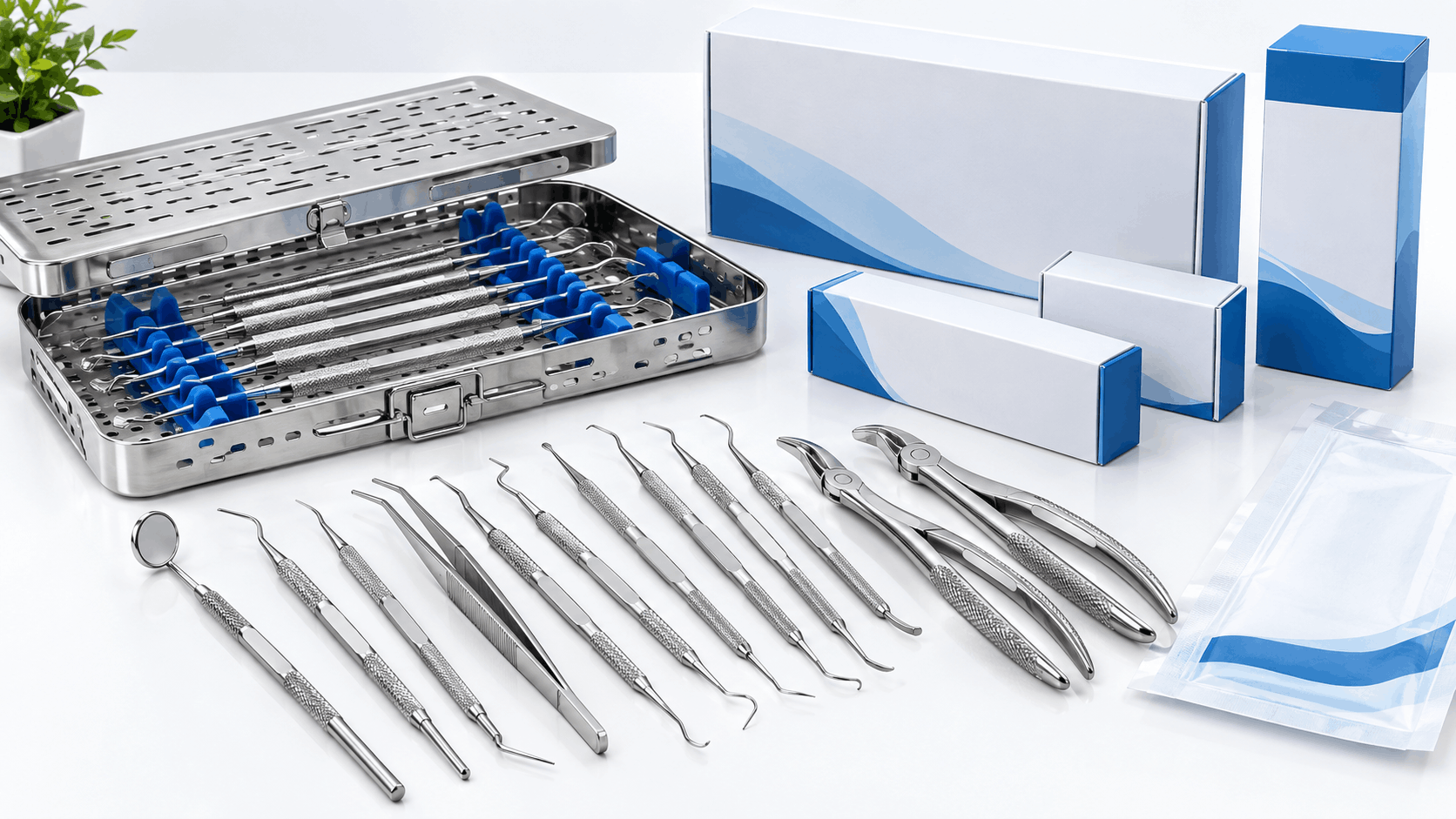
OEM and private label
- OEM: The manufacturer produces instruments to your design.
- Private label: The manufacturer applies your brand to standard or slightly modified instruments.
What can be customized?
- Laser marking of logo, item code and UDI
- Handle shape, diameter and length
- Color-coded rings or silicone handles
- Custom instrument sets and cassette layouts
- Packaging, pouches and labels
- Multi-language IFUs
Tips for private label success
- Confirm the minimum order quantity early.
- Approve a sample before mass production.
- Make sure labels meet FDA or MDR requirements, including who is listed as the manufacturer.
- Clarify design ownership and confidentiality.
- Agree on inspection rules in writing.
Under both FDA and MDR rules, private labelers can take on manufacturer responsibilities, so speak with your supplier and a regulatory expert before you start. Learn more about OEM and private label dental instruments manufacturing from Orthogear Surgical.
Inspecting Your Order and Caring for Instruments
Inspection on arrival
- Quantity and codes: Make sure they match the invoice.
- Packaging: Check for damage or moisture.
- Visual check: Look for scratches, rough edges, stains and uneven finish.
- Functional check: Test moving parts, alignment and cutting edges.
- Markings: Confirm that laser marks, lot numbers and UDI are clear.
- Documents: Verify certificates, IFUs and labels.
Take photos of any problems and report them within the time frame set in your agreement.
Cleaning and sterilization
New instruments should be cleaned and sterilized before first use. Follow the manufacturer’s IFU and your local infection-control rules (such as CDC guidelines in the USA or national guidelines in Europe).
Daily care
- Clean instruments right after use.
- Use neutral pH cleaners instead of strong chloride-heavy ones.
- Do not mix different metals in ultrasonic baths.
- Rinse with clean or distilled water.
- Dry instruments completely before storing.
- Apply instrument lubricant to moving parts.
- Do not overload the autoclave.
- Sharpen cutting instruments regularly.
- Remove damaged or corroded instruments from use.
Storage
Keep sterilized instruments in sealed pouches or cassettes in a dry place. Store unused instruments in their original packaging in a cool, dry area. Good care makes stainless steel dental instruments last for years, while poor care can ruin even expensive ones.
Common Mistakes Buyers Make
- Choosing on price alone. Replacement costs can cancel out any savings.
- Skipping samples. Photos do not show steel quality or how instruments feel in use.
- Not verifying certificates. Check that they are genuine, and confirm the scope, expiry date and manufacturer name.
- Ignoring the steel grade. “Stainless steel” with no grade is a warning sign.
- Overlooking landed cost. Freight, duties, VAT and brokerage add up.
- Ignoring market rules. FDA and MDR requirements differ, and a supplier who only knows one market may not support the other.
- Forgetting labels and language. Non-compliant labels can delay sales.
- Paying the full amount in advance to an unknown seller. Use staged payments.
- Not checking factory capacity. Overloaded factories deliver late and produce poor work.
- No written quality standards. Without them, resolving problems is difficult.
- Ignoring after-sales support. Ask about replacements and response time before buying.
- Buying too much too soon. Start with a trial order.
- Poor storage. Even good instruments deteriorate with careless handling.
Starter Wholesale List for a New Dental Clinic
Use this as a starting point and adjust quantities based on the number of chairs and how often you sterilize.
- Examination: Mouth mirrors and handles, explorers, periodontal probes, cotton pliers
- Restorative: Spoon and disc excavators, amalgam and composite instruments, carvers, burnishers, matrix retainers, cement spatulas
- Hygiene: Hand scalers, Gracey curettes, universal curettes
- Surgical: Upper and lower extraction forceps, elevators, surgical scissors, tissue forceps, needle holders, periosteal elevator
- Endodontic: Files, pluggers, spreaders, rubber dam kit
- Storage and sterilization: Cassettes, trays, sterilization pouches, cleaning and lubricating solutions
Rule of thumb: Keep two to three instrument sets per chair so that procedures are never delayed by reprocessing or broken instruments.
Trends in the Wholesale Dental Supplies Market
- Stricter regulatory scrutiny: Buyers in the USA and EU are asking for more documentation, UDI and traceability. Suppliers who can prove compliance win business.
- Color-coded and ergonomic designs: Silicone handles and lightweight designs reduce hand fatigue and make instruments easier to identify.
- Coated and specialty surfaces: Non-stick and anti-glare finishes are becoming more common.
- Single-use and limited-use items: Infection control concerns have increased demand for disposable files and accessories.
- Private label growth: More dental sellers are building their own brands with flexible manufacturers.
- Sustainability: Durable stainless steel instruments and reduced packaging waste appeal to environmentally conscious clinics.
- Digital buying: Online catalogs and virtual factory tours make global comparison easier, which makes verification even more important.
Why Buy from Orthogear Surgical
Orthogear Surgical is a dental and surgical instruments manufacturer and supplier based in Sialkot, Pakistan, working with clinics, distributors and private label brands in the USA, Europe and worldwide. We focus on making bulk buying simple, transparent and safe.
What we offer:
- Wide product range: Surgical, periodontal, orthodontic, endodontic, restorative and examination instruments, plus sterilization accessories.
- High-quality stainless steel: Documented steel grades with proper heat treatment and passivation.
- Controlled production: Every production step is monitored, and batches can be tracked.
- Documentation support: Certificates and labels aligned with US and EU requirements. (Add your actual certifications here: ISO 13485, CE, FDA registration.)
- Flexible order sizes: Trial orders for new customers and large volumes for distributors.
- Private label and OEM: Laser marking, custom sets, packaging and multi-language labels.
- Global delivery: Air and sea shipping with FOB, CIF and DDP options.
- Sample program: Test our instruments in your clinic before you commit to a bulk order.
We treat every order as the start of a long-term partnership. If you need a dental instruments supplier for the American or European market, our team is ready to help.
Request a catalog, samples or a custom wholesale quote from Orthogear Surgical today.
Frequently Asked Questions
What are wholesale dental instruments?
Wholesale dental instruments are tools such as mirrors, explorers, scalers, forceps, elevators and orthodontic pliers sold in large quantities at a lower per-unit price, usually directly from a factory or large distributor.
How do I choose a dental instruments supplier?
Check for ISO 13485 and market-specific documents (FDA registration for the USA, CE and MDR documents for Europe). Ask for material details, order samples, test them in real conditions, compare prices and evaluate communication and after-sales support. Start with a trial order.
What certifications do dental instruments need in the USA?
Most manual dental instruments are Class I devices, and many are exempt from 510(k). The manufacturer must still register its facility and list its devices with the FDA, and foreign manufacturers must appoint a US Agent. ISO 13485 shows a solid quality system.
What do I need to import dental instruments into the EU?
Instruments need CE marking under the MDR, a Declaration of Conformity, an EU Authorized Representative for non-EU manufacturers, correct labels and instructions in local languages, and UDI information. As an importer, you must also verify compliance and keep records.
Is FDA registration the same as FDA approval?
No. Registration means the company is registered and its devices are listed. It does not mean the FDA has approved the product.
What is the best steel for dental instruments?
AISI 420 martensitic stainless steel is widely used for cutting instruments because it holds an edge well. AISI 304 and 316 suit trays and items where corrosion resistance is the priority. Titanium is used for premium implant and microsurgical instruments.
What is the minimum order quantity for dental instruments?
MOQ depends on the supplier and product. Standard items may start at a dozen pieces, while custom, OEM and private label items require more, and bulk programs often start at 500+ pieces. Many suppliers allow mixed-item orders.
Can I put my own brand on dental instruments?
Yes. Many manufacturers offer private label and OEM options. Confirm the MOQ, approve samples, and make sure labeling follows FDA or MDR rules, because private labeling can bring extra regulatory duties.
Should I buy from a manufacturer or a distributor?
Manufacturers typically offer better prices, customization and traceability but require higher MOQs. Distributors offer variety, faster shipping and lower MOQs at a higher price. Some buyers work with both.
How long does shipping to the USA or Europe take?
Air delivery usually takes a few days once the order is ready, while sea freight can take several weeks depending on the route and customs. Production time is added to shipping time.
Who pays import duties and taxes?
It depends on the Incoterm. With EXW, FOB and CIF, the buyer typically pays import duty and VAT or sales tax. With DDP, the supplier handles them. Always calculate the full landed cost.
How long do dental instruments last?
With proper cleaning, sterilization and sharpening, high-quality stainless steel instruments can last many years. Low-quality instruments may last only a few months.
What is the difference between forged and cast instruments?
Forged instruments are pressed from heated steel and have a dense, strong structure. Cast instruments are made by pouring metal into molds and can be more porous. Forged instruments are usually stronger and last longer.
Final Thoughts
Buying instruments in bulk is one of the best ways for clinics, hospitals, schools and distributors in the USA and Europe to save money and secure consistent quality. Success comes from informed decisions. Look beyond the price to the steel type, the manufacturing process, regulatory documents, sample performance, communication and after-sales support.
Key takeaways:
- Understand your needs and the market you want to serve.
- Compare several suppliers and manufacturers.
- Confirm ISO 13485, FDA registration for the USA, and CE/MDR documents for Europe.
- Ask about the steel type and test samples under real conditions.
- Compare landed cost, including shipping, taxes and VAT.
- Agree on MOQ, payment and warranty terms in writing.
- Begin with a trial order and grow from there.
- Inspect every shipment and follow proper sterilization methods.
Follow this process to protect your patients, your team and your investment while building a supply relationship that supports your business for years.
Ready to buy dental instruments in bulk? Contact Orthogear Surgical for a catalog, samples and a personalized wholesale quote.