
What Is a Dental Surgical Instruments Supplier?

What Is a Dental Surgical Instruments Supplier? A Complete Buyer’s Guide
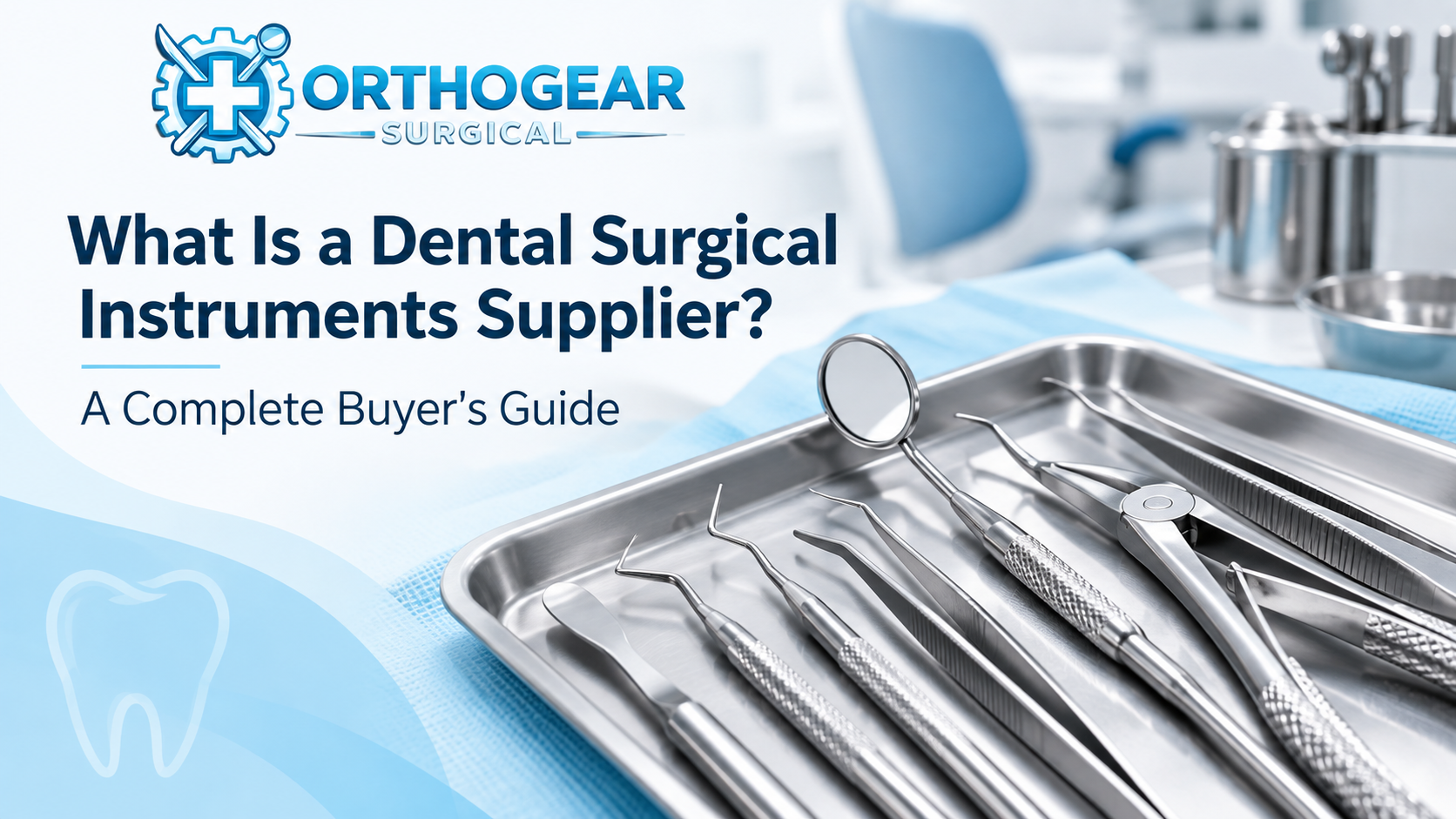
If you run a dental clinic, manage hospital procurement, work as a distributor, or want to launch your own instrument brand, choosing the right supplier is one of the most important decisions you’ll make. Get it wrong, and you risk instruments that corrode, break mid-procedure, or fail to meet regulatory standards. Get it right, and you gain a long-term partner who keeps quality consistent and your business running smoothly.
This guide covers what a dental surgical instruments supplier actually is, how suppliers differ from manufacturers, what to check before you order, and why Sialkot, Pakistan has become the world’s leading hub for this industry.
What Is a Dental Surgical Instruments Supplier?
A dental surgical instruments supplier is a business that provides the tools dental professionals use — extraction forceps, elevators, scalers, curettes, implant kits, and surgical sets. Explore our full range of dental instruments to see what this typically includes. But “supplier” is a broad term. It could mean:
- A factory that manufactures instruments in-house and sells directly.
- A trading company that buys from various factories and resells, sometimes under its own label.
- A distributor importing in bulk and reselling locally.
- An online seller with no direct manufacturing relationship at all.
For a buyer, what matters most is: who is accountable for the quality and delivery of what arrives at your door? That’s why it’s essential to know exactly who you’re dealing with before you commit. You can learn more about our own background on our About Us page.
Supplier vs. Manufacturer vs. Distributor
Manufacturer — physically produces the instruments (forging, milling, hardening, polishing, inspection). Offers OEM and private-label manufacturing services, better bulk pricing, and full accountability for defects — but often requires higher minimum order quantities (MOQs).
Distributor/Wholesaler — buys in bulk from a manufacturer and resells locally, offering faster delivery and smaller order sizes, usually at a higher per-unit price due to added margin. If you’re a distributor or importer looking for a direct source, see our wholesale partnership options.
Many companies today are hybrid manufacturer-suppliers — running their own factory while selling direct to clinics and distributors worldwide, cutting out extra markup layers. This is increasingly common among Sialkot-based manufacturers and generally means better pricing and more direct accountability for buyers.
Why It Matters
- Pricing — every middleman layer adds cost. Know whether you’re paying factory price or resale price.
- Accountability — a manufacturer can trace a defect back to its batch and material certificate; a reseller often can’t.
- Customization — only a company with real production control can offer OEM branding or custom specs.
- Compliance — manufacturers can usually provide direct, verifiable certification; resellers should be able to pass it along, but confirm this.
What to Check Before Choosing a Supplier
Certifications — Ask for ISO 13485 (medical device quality management), ISO 9001, CE marking (for EU), and FDA registration (for the US) where relevant. Request actual certificate copies and verifiable numbers, not just a logo.
Material Quality — Common grades are SS 410 and SS 420 (strong, good edge retention — used for forceps and scissors) and SS 316 (superior corrosion resistance). A trustworthy supplier specifies the exact grade per instrument, not a vague “high-quality steel” answer.
Manufacturing & QC Process — Ask how instruments are inspected: raw material checks, dimensional and functional testing, final visual inspection before packaging.
MOQ — Clarify minimum order per product, whether quantities can be mixed across SKUs, and whether sample orders below MOQ are possible. For larger orders, check our bulk order terms.
Sample Policy — Never place a bulk order without inspecting samples first — check finish, joint tension, tip alignment, and packaging. A supplier who discourages sampling is a red flag. Read our own sample policy for an example of how this should work.
OEM/Private Label — If building your own brand, ask about logo engraving, custom packaging, MOQs for branded runs, and turnaround time. See how our custom manufacturing process works.
Pricing Basis — Confirm whether quotes are EXW, FOB, CIF, or DDP, plus any charges for customization or documentation.
Shipping — Confirm carriers (FedEx, UPS, DHL, DPD), separate production vs. shipping timelines, tracking, and who handles customs.
Communication & Track Record — Responsiveness before you pay is usually a preview of support after. Check years in business, countries served, and references.
Why Sialkot, Pakistan Is a Global Hub
Sialkot’s surgical instrument industry dates back over a century, evolving from small repair workshops into one of the world’s largest manufacturing clusters for dental, orthopedic, and surgical instruments. Its advantage comes from:
- A concentrated industrial cluster — hundreds of manufacturers plus supporting industries (forging, polishing, packaging, export logistics) all located together, enabling faster production and tighter quality control.
- Generational expertise — skilled metalworking knowledge passed down over decades.
- Massive export scale — supplying hospitals and clinics in over a hundred countries.
- Rising quality standards — many manufacturers now hold ISO 13485/9001 certification and pursue CE marking and FDA registration, challenging the outdated idea that low-cost hubs mean lower quality.
- Direct factory pricing — a localized supply chain means fewer markup layers and genuinely lower landed costs.
- Deep OEM/private-label experience — decades of producing for international brands, meaning the infrastructure for custom branding is already mature.
Common Mistakes to Avoid
- Choosing purely on price without checking material grade or QC process
- Skipping sample inspection before a bulk order
- Comparing quotes on different pricing bases (EXW vs. DDP)
- Assuming “supplier” always means “manufacturer”
- Underestimating that production time and shipping time are separate
- Not clarifying the defect/return policy upfront
- Trusting certification claims without verifying them
Quick Vetting Checklist
- Confirmed manufacturer vs. reseller status
- Reviewed ISO/CE/FDA certificates directly
- Got specific material grades per product
- Understood the QC process
- Ordered and inspected samples
- Clarified MOQ, pricing basis, and shipping timelines
- Asked about OEM/private-label options
- Got the defect/return policy in writing
Final Thoughts
Choosing a dental surgical instruments supplier shouldn’t come down to price or a polished website alone. It should rest on verified certifications, transparent material sourcing, clarity on who actually manufactures your instruments, and a willingness to let you inspect samples before you commit to a bulk order. Buyers who vet suppliers properly end up with better instruments, fewer disputes, and long-term partners rather than one-off transactions.
Looking for a certified, factory-direct dental, orthopedic, and surgical instruments manufacturer? Explore our product range or contact us directly for samples, bulk pricing, and OEM/private-label options.