
Steps to Launch Your Private Label Dental Instruments Brand
Introduction
For distributors, importers, and other dental supply companies looking to build a private label dental instruments brand, this is one of the fastest ways to evolve from a reseller to a genuine name in one of the most competitive markets in healthcare equipment. Rather than competing against other resellers of the same catalog on price alone, launching your own private label dental instruments brand enables a distributor to dictate a premium price point, control the design and packaging, and work with an established manufacturer to deliver the instruments with required quality and service.
Private labeling implies a specific manufacturing route, which is best described as production according to an established and proven design, with all branding replaced by the buyer’s details (company name, logo). This manufacturing arrangement is slightly different from OEM (Original Equipment Manufacturing), where the buyer usually specifies design changes or particular attention to a component manufacturing process.
While both routes involve a manufacturing partner producing instruments according to the buyer’s specifications, OEM manufacturing usually implies a higher degree of design involvement on the buyer’s part. For importers and distributors just starting to engage in private labeling, OEM manufacturing may be more challenging due to higher minimum order quantities (MOQ) and design input needs. In many cases, OEM manufacturing is a logical next step for a private label brand that has gained credibility in the market and wishes to differentiate its product offering.
In both cases, the private label or OEM manufacturing route, a distributor has to carefully select a manufacturer that can deliver on all fronts: production volume, quality, branding flexibility, logistics, and pricing. The importance of the supplier selection step cannot be overstated: it is the single most important decision in private labeling.
It is also worth noting that private labeling is rarely an either/or scenario. For a distributor or importer just starting to build a private label brand, a hybrid sales strategy may be the best option to minimize risk while building early brand credibility. In other words, while a private label brand is being developed and distributed, a distributor may continue to resell popular third-party catalog instruments in parallel.
All that said, let’s take a look at the private labeling process from the perspective of a distributor/importer and identify the main steps of developing a private label instrument brand.
Steps
1. Define objectives of developing a private label brand
Prior to even sourcing a single instrument, it is critical to define the purpose of a private label brand for the distributor/importer and the company as a whole. For many, the decision to develop a private label brand is not straightforward and requires considerable analysis. Distributors and importers may have different commercial and operational objectives that should inform the rest of the private label development decisions, namely, initial product range, pricing strategy, and even choice of manufacturing partner.
Private label brands may be developed for a variety of reasons, including:
Higher profit margins. Compared to reselling an existing brand, a private label product involves fewer competitors at any stage of the supply chain, therefore enabling the distributor to dictate pricing terms.
Customer retention. A private label product range helps to establish a recognizable brand with loyal customers. This is especially true for dental instruments, where the same buyer may purchase the same SKUs repeatedly.
Differentiation. When competing against other distributors, a carefully crafted private label brand helps to stand out from the crowd.
Long-term value. A private label brand is a valuable asset that can potentially be sold or franchised in the future. Unlike reselling other brands, a private label product range has the potential to become a recognizable name within the industry.
Regardless of reasons for embarking on a private labeling journey, it is critical to clearly define objectives at the outset because the objective will inform all other decisions for the life of a private label brand.
2. Define the initial product range
When starting to develop a private label brand, it is often a good idea to focus on one category of dental instruments rather than launch a full product range right away.
A good initial product range may comprise a few categories of dental instruments and 15-30 SKUs, depending on the complexity and MOQ of a particular manufacturing partner. The initial product range should be carefully selected with the following considerations in mind:
Core category. A good idea is to focus on one category of dental instruments (e.g., extraction forceps) and establish a strong presence in this category with multiple SKU options. Dental instruments are a broad category, and a good starting point is to source products with consistent demand and recognizeability, such as dental forceps, elevators, scalers, and general dental exam sets.
SKU range. As mentioned above, it is a good idea to limit the initial launch to 15-30 SKUs. This helps to streamline the ordering and inspection process, especially for a first-time private label brand. Distributing the initial SKUs across a few product categories (dental, orthopedic, general surgery) is not recommended, at least not until a private label brand becomes more recognizable in the market.
Materials and specifications. Where possible, use existing and well-established instrument designs rather than request complete OEM development (see below). This will reduce costs and MOQ in many cases, particularly for manufacturers who have these designs in their regular production catalog.
Once an initial product range is established and achieves consistent demand in the market, a private label brand can consider expanding its product range into other categories, such as orthopedic or general surgery instruments. Such an expansion has much lower risk because the brand name and manufacturing partner have already been validated by the market.
3. Identify and qualify private label manufacturing partners
This step is deceptively simple but is one of the most important stages of private labeling. In many ways, a private label brand is only as good as its manufacturing partner. A distributor/importer has to identify and qualify potential manufacturing partners that offer the best value in terms of production volume, MOQ, quality, branding flexibility, logistics, and pricing.
Key questions to ask when evaluating a potential private label manufacturing partner include:
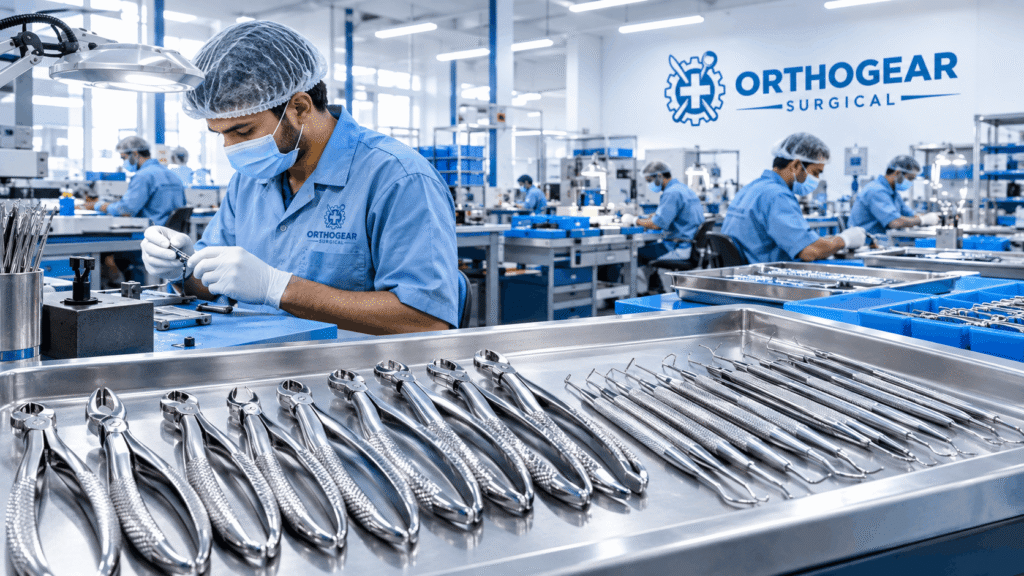
Is the manufacturing partner ISO 13485 certified? This is the international standard for quality management systems in medical device manufacturing. Any competent medical device manufacturer should be ISO 13485 certified, and this level of quality auditing is critical for a private label brand that wishes to establish itself as a reliable supplier.
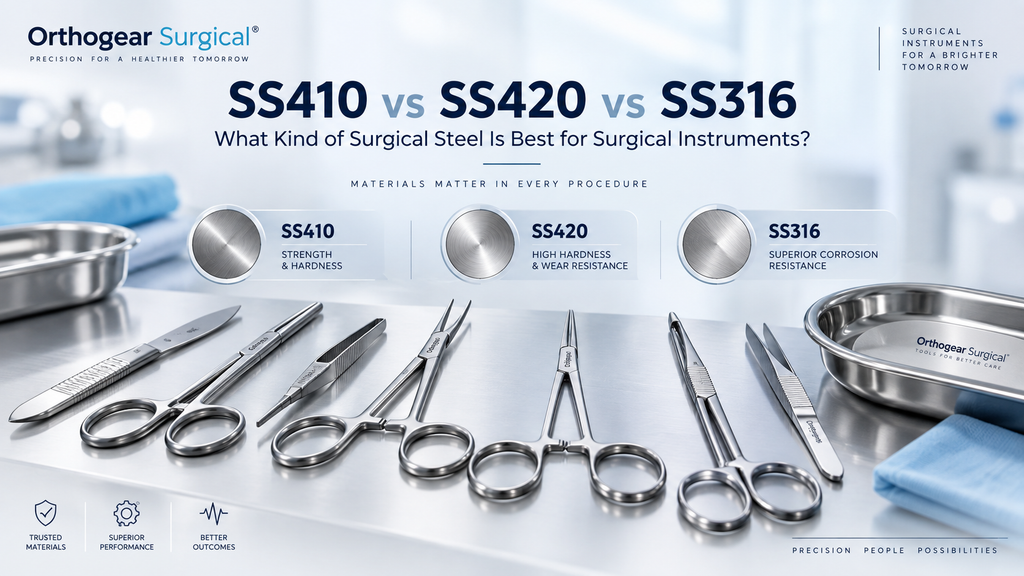
Does the manufacturing partner use surgical steel for the instruments? More specifically, the manufacturing partner should be able to specify the steel grade (e.g., SS410, SS420, or SS316) for each product category.
Does the manufacturing partner have experience with private labeling and OEM manufacturing? A supplier that regularly handles OEM and private label orders will already have systems in place for branding, packaging, and documentation.
Does the manufacturing partner offer a sample policy? A competent private label manufacturing partner will offer physical samples of finished instruments to a potential buyer. The samples allow the buyer to visually inspect the product quality, finish, and weld integrity. Where possible, the buyer should also request a physical inspection of material hardness, especially for cutting instruments.
What MOQ does the manufacturing partner have for private label brands? Unless a distributor has substantial purchasing power, a large MOQ (minimum order quantity) requested by a manufacturing partner is a deal-breaker.
Does the manufacturing partner provide direct factory cooperation? In other words, does the manufacturer sell directly to the distributor/importer, or are there other trading companies involved in the transaction? Dealing directly with the manufacturing partner usually has advantages in terms of pricing, logistics, and overall flexibility. A competent manufacturing partner will understand this and will seek to establish a direct relationship with a competent distributor.
Does the manufacturing partner have shipping/export experience for the target market region (the USA, the UK, Canada, the UAE, Saudi Arabia, etc.)?
4. Order samples
It goes without saying that before committing to a large MOQ with a manufacturing partner, a distributor has to order physical samples to ensure that the instruments meet all quality control requirements.
While the catalog specifications may seem adequate, it is always a good idea to request an inspection of actual instrument samples. Key inspection points include:
- Instrument alignment and finish: in particular, proper alignment of forceps beaks.
- Material hardness: this determines how long the edge of a cutting instrument will hold.
- Weld integrity: most instruments have at least one weld, and it is critical to ensure that the weld is strong and will not crack during normal use.
- Packaging and brand placement: many manufacturers offer private label branding in the form of a laser-engraved logo on each instrument, in addition to the general branding on the packaging.
By inspecting physical samples, the distributor ensures that the instruments look presentable when delivered to the end customer. This is especially important for the initial product launch: an improperly packaged product runs the risk of being returned by the customer.
Testing the samples through multiple sterilization cycles is also a good way to identify potential issues with instrument finish or hinge integrity. Distributors considering multiple manufacturers for their private label brand should always request samples, even if time is of the essence. Once the samples are received, the potential distributor has an opportunity to compare the quality of goods and general presentation (packaging, brand placement) of different manufacturers. This is critical in establishing realistic expectations for the first MOQ.
5. Define brand requirements
With a manufacturing partner shortlisted and initial samples inspected, the next logical step is to begin developing the brand requirements for the private label instruments. Brand requirements typically include visual aspects (brand name and logo placement) and general requirements (packaging, documentation, etc.).
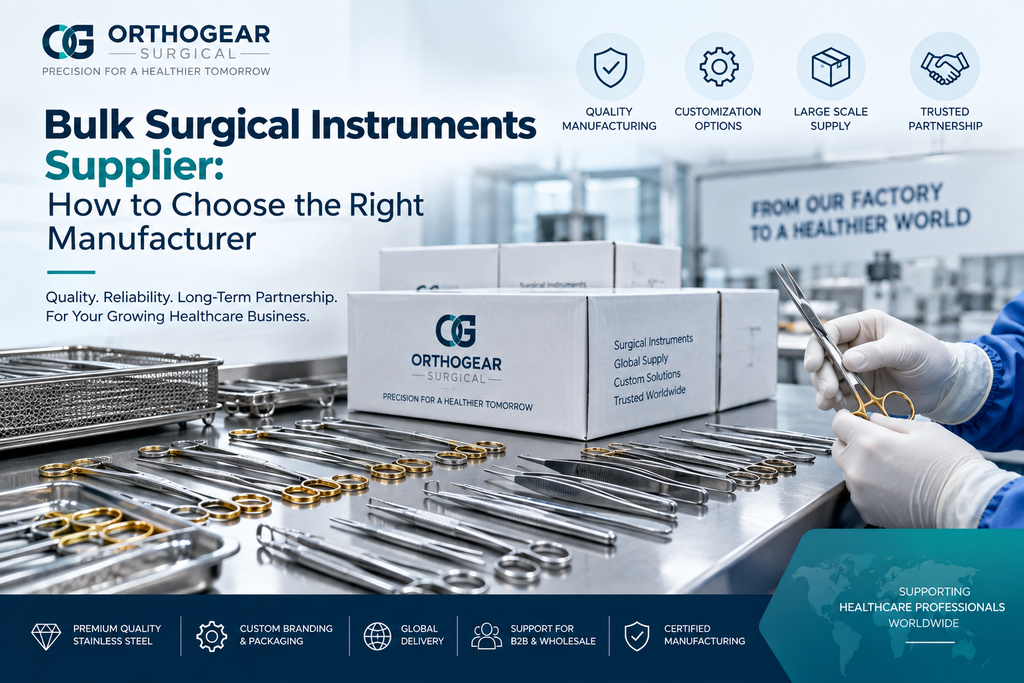
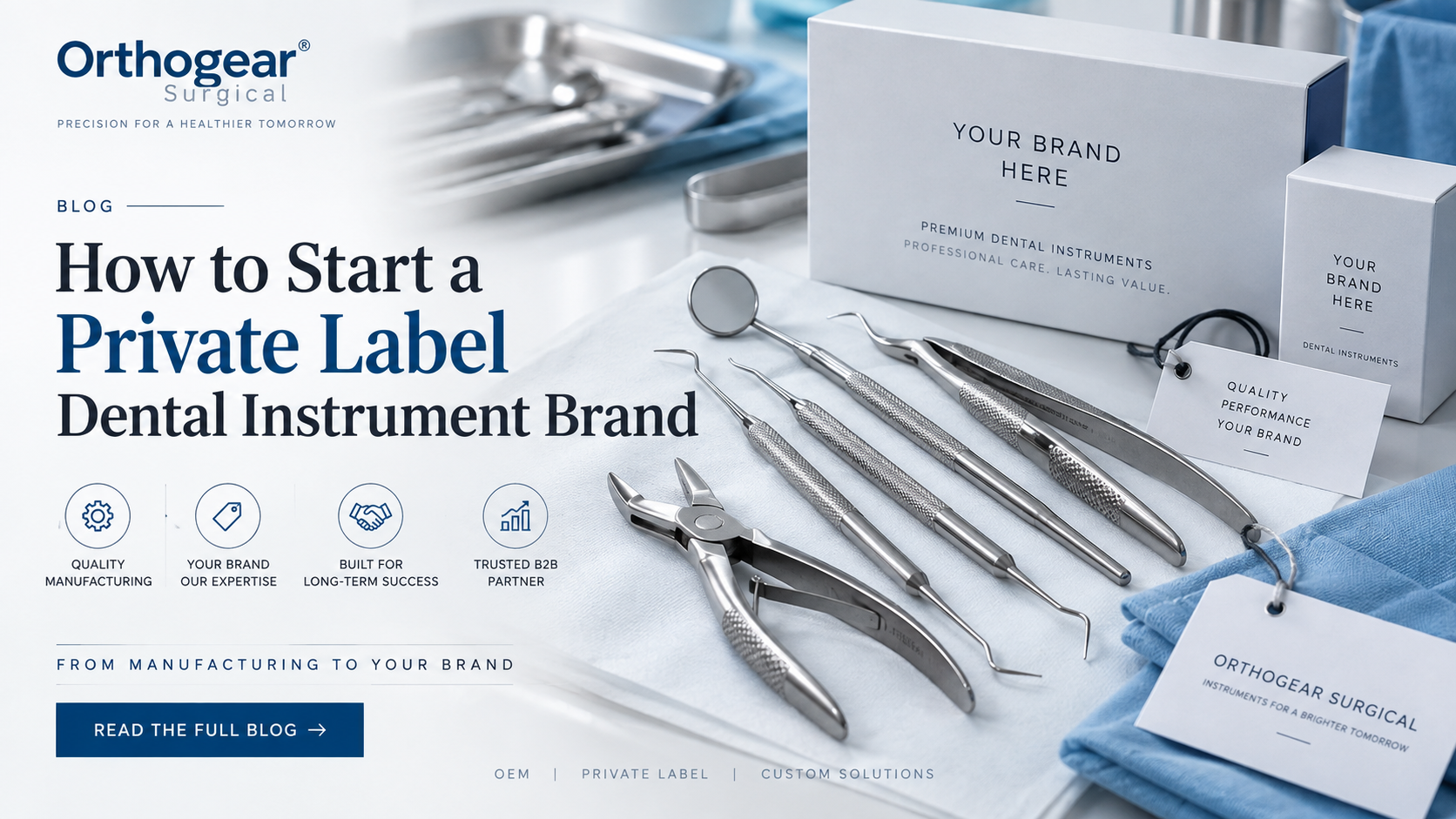
Most manufacturers that offer private label branding will be able to laser-engrave a brand logo on the instruments and provide general branding on the packaging. Some manufacturers offer additional options, such as product-specific packaging, documentation, and other services. Product documentation requirements may vary depending on the target market and should always be discussed with the manufacturing partner.
Regardless of the specifics, a consistent visual theme should be used for all instruments in a private label product range, at least for the initial release.
6. Set pricing and product positioning strategy
Compared to reselling an existing brand, a private label brand has significantly more flexibility in terms of pricing and product positioning. However, this flexibility should be carefully considered in light of the cost per unit, desired profit margin, competitive landscape, and other factors.
Key considerations when setting pricing and positioning strategy for a private label brand include:
Landed cost calculation. The landed cost (cost per unit + shipping + duties) should inform the final sale price, rather than the manufacturing cost alone.
Competitive positioning. A private label brand typically positions itself somewhere between generic and established brand instruments. Distributors should identify the most common competitors at the launch stage and understand what value proposition (price, quality, etc.) the private label brand will offer compared to these competitors.
Profit margin requirements for different buyers. Unless a distributor sells directly to hospitals or large institutional buyers, the pricing strategy should reflect the typical profit margin requirements for distributors and resellers.
Potential for introductory pricing. To offset higher MOQ costs at the launch stage, some private label brands use introductory pricing for their initial buyers.
7. Distribute samples to early customers
At this point, a private label brand has a defined product range, manufacturing partner, and pricing strategy. The next step is to actually sell the instruments, which typically starts with distributing free samples to early customers and discussing long-standing supply opportunities. The best way to ensure early sales is to utilize an existing customer base, if one exists. Distributors and importers that have been reselling catalog instruments have a distinct advantage at this stage because they can encourage existing clients to switch to the private label brand.
Many distributors find that offering a sample kit to prospective customers is an effective way to generate early sales. Similar to the sample inspection described above, a sample kit allows a prospective customer to evaluate the product range before making a larger purchase commitment.
If the initial product range is small (a few SKUs), a prospective customer may request a small order to test the waters. It is always a good idea to request feedback from early adopters, as this feedback may be critical in fine-tuning the product range, branding, and other elements of a private label brand.
Another effective way to gain early buyers is to use a wholesale sales model. Many private label brands use a wholesale sales model to reach out to other distributors in the target market region. This approach has the advantage of leveraging the existing wholesale infrastructure without the need to directly sell to end users.
8. Expand the product range, scale the brand
Once a private label brand has achieved consistent sales in the target market region, the focus shifts to expanding the product range and building long-standing supply relationships with existing and new buyers. At this stage, a private label brand may consider the following growth levers:
Expand the product range: launch additional categories of medical instruments (orthopedic, general surgery, etc.). A private label brand with an established presence in one category can use the credibility of the existing brand to launch new categories and SKUs.
Move from private label brands to OEM manufacturing: as a private label brand gains credibility, it may make sense to move from private labeling (production of instruments with established designs) to OEM manufacturing (production of instruments with modified designs or materials).
Enter new market regions: a private label brand that has been successfully sold in one market region (e.g., the USA) can consider expansion into new geographic regions, provided that the manufacturing partner has the necessary experience with shipping/export in these regions.
Establish long-standing supply relationships with the manufacturing partner: once a private label brand has gained sufficient credibility with buyers, it can work with the manufacturing partner to establish more favorable terms (lower MOQ, favorable pricing, etc.).
Common Mistakes to Avoid When Building a Private Label Brand
Skipping sample inspection to save time and money: this is arguably the biggest mistake a private label distributor can make. A single batch of poorly made instruments can ruin the reputation of a private label brand, especially when a distributor has to issue refunds or replace defective instruments.
Seeking the lowest possible manufacturing price: while it is important to optimize costs, the cheapest manufacturing option may not always be the best option, particularly if it sacrifices quality.
Overreaching at the launch stage: a private label brand should start small and only introduce a few product categories at the launch stage.
Underestimating the importance of documentation: proper documentation (material certifications, import/export documents) is essential to ensure that buyers can actually use the purchased instruments.
Failing to take customer feedback into account: early customer feedback is the single most important factor in the success of a private label brand. Distributors often fail to follow up with early buyers, especially if they were the first to purchase instruments from this distributor.
Not fostering a good relationship with the manufacturing partner: a competent manufacturing partner will offer favorable terms (pricing, MOQ) to a long-standing and reliable buyer.
FAQ
What is the difference between private label and OEM dental instruments?
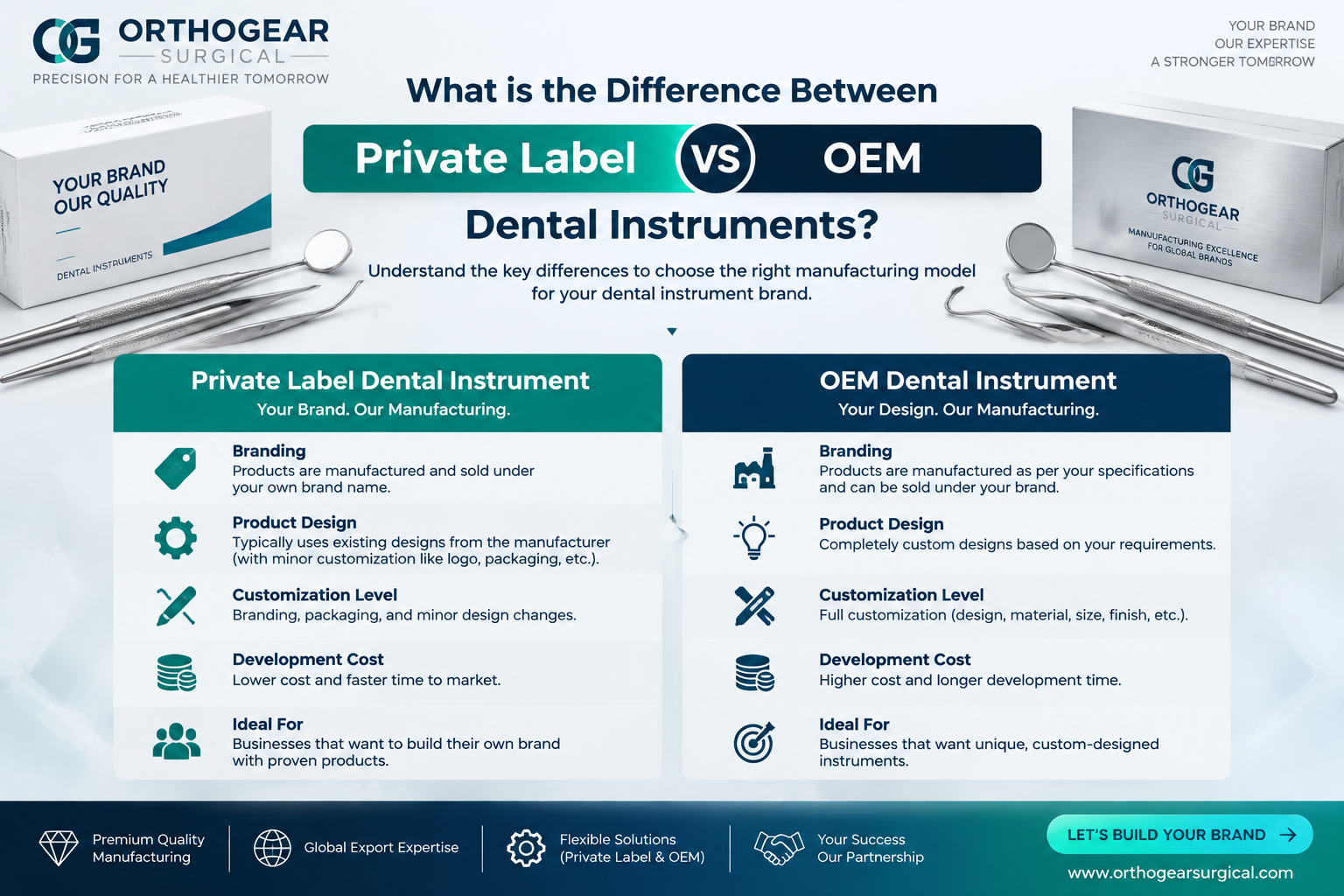
Private labeling implies that a manufacturing partner produces an instrument according to an established design, with all branding (company name, logo) replaced with the private label buyer’s information. OEM manufacturing usually implies that the buyer specifies certain design changes to an existing instrument design.
How much does it cost to start a private label dental instrument brand?
Costs vary significantly depending on the product range and MOQ, but most manufacturers have appropriate product range options and MOQ for a distributor looking to establish a private label brand.
Do I need ISO certification to sell private label dental instruments?
The private label brand itself does not need ISO certification, but it is always a good idea to work with an ISO-certified manufacturing partner because this provides an additional level of quality control.
How long does it take to launch a private label dental instrument brand?
Time to launch depends on the manufacturing partner, but it is always a good idea to allocate several months for the end-to-end process, from initial supplier qualification to first bulk order.
Can I start a private label brand with a limited product range and then expand it?
Yes, in fact, it is a good idea to limit the initial product range to 15-30 SKUs.
What should I look for in a private label manufacturing partner’s sample policy?
Always request a physical inspection of samples, not just a catalog page. Where possible, conduct a material hardness test to ensure that the instruments will hold an edge.
Ready to build your own private label dental instrument brand? Get in touch to discuss OEM and private label options or request samples to see the quality firsthand.