


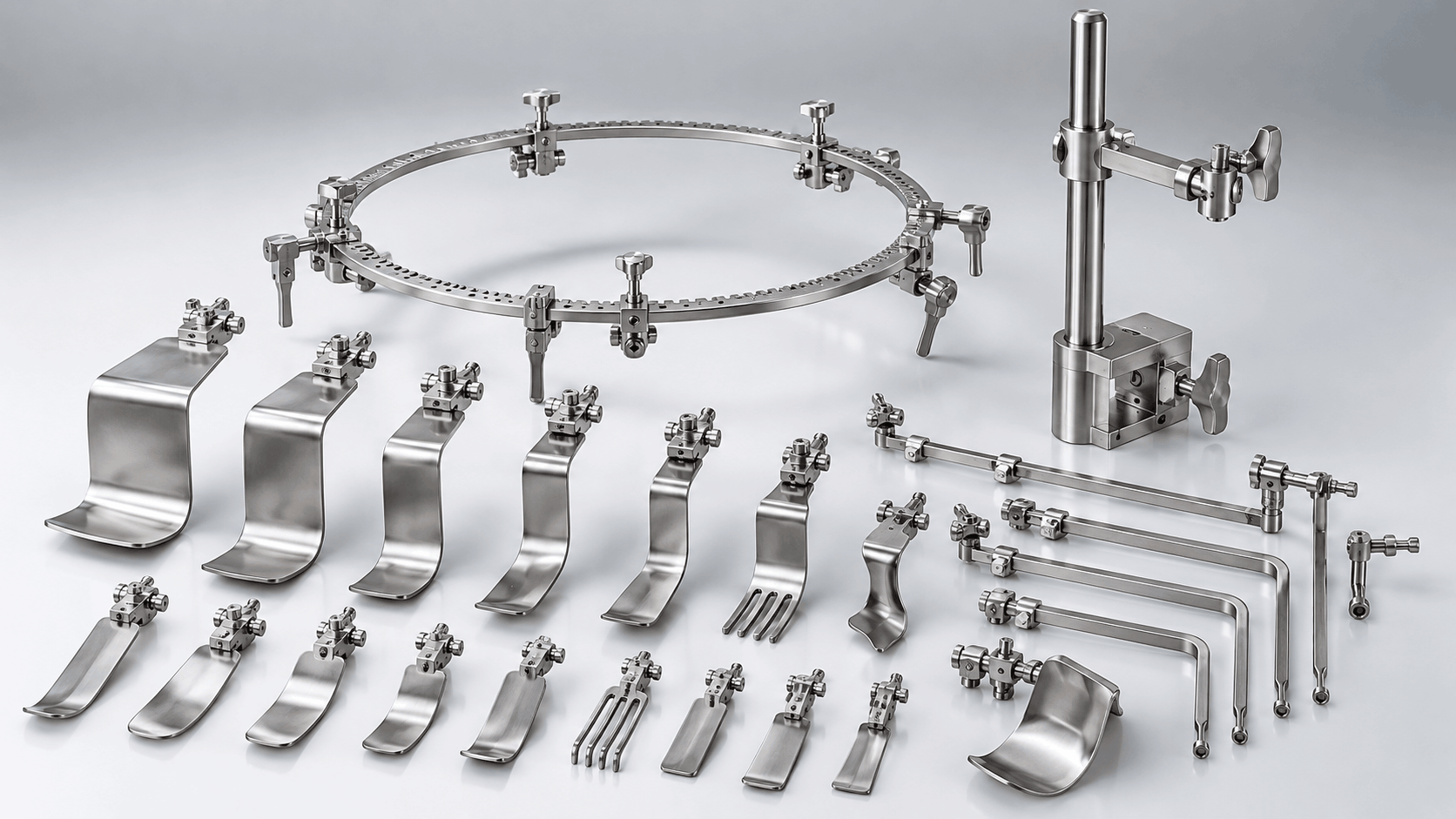
The Bookwalter surgical retractor is one of the most commonly used exposure systems in open abdominal and pelvic surgery. The quality of exposure it provides directly affects the safety, efficiency, and success of every abdominal procedure. A stable, self-retaining retractor that does not require constant manipulation by assistants lets the surgeon concentrate on the operation itself.
In this detailed guide, we cover everything you need to know about the Bookwalter retractor: its mechanism, components, indications, and differences from similar devices. We also discuss how to buy a high-quality surgical retractor and how to care for it in your facility. This guide is useful for surgeons, hospital procurement managers, operating room nurses, surgical instrument distributors, students, and anyone interested in the subject.
Table of Contents
- What Is a Bookwalter Surgical Retractor?
- How Does a Bookwalter Retractor Work?
- Main Components of a Bookwalter Retractor Set
- 7 Amazing Facts You Must Know
- Types of Bookwalter Retractor Blades
- Surgical Applications
- Advantages and Limitations
- Bookwalter vs Other Retractors
- How to Choose the Best Bookwalter Surgical Retractor
- 7 Mistakes to Avoid When Buying
- Cleaning, Sterilization, and Maintenance
- Troubleshooting Common Problems
- Storage and Handling Tips
- Frequently Asked Questions
- Conclusion
What Is a Bookwalter Surgical Retractor?
A Bookwalter surgical retractor is a self-retaining retractor system primarily used in open abdominal, pelvic, and retroperitoneal surgeries. It consists of a circular or oval metal ring, to which various blades can be attached and adjusted. The ring is usually mounted on a vertical post fixed to the operating table. By retracting tissues and organs with its blades, the system provides wide exposure of the operative field.
The device puts the surgical team at ease by removing the need for assistants to hold hand-held retractors throughout the procedure. The blades can be removed, rearranged, or replaced several times during surgery, depending on the changing needs of the exposure.
A Bookwalter surgical retractor is also known as a Bookwalter retractor system or a Bookwalter retractor set. These names all refer to the same medical device.
If you are exploring other tools used alongside retractors, you can browse our surgical instruments catalogue or visit the online shop.
How Does a Bookwalter Retractor Work?
The working principle of a Bookwalter surgical retractor revolves around a stable external frame that holds a number of independently adjustable blades. These are the steps involved in setting it up:
- The table post is first fixed to the side rails of the operating table. A firm clamping mechanism prevents the post from wobbling or rotating.
- The ring is then attached to the post with a clamp and positioned over the incision site. The size and shape of the ring should correspond to the length and width of the patient’s incision.
- Suitable blades are selected and attached to the ring with blade holders. The holders usually allow limited adjustment of the working surface.
- The blades are inserted into the surgical field and locked by tightening or by a ratcheting mechanism. The self-retaining function allows the surgical team to focus on the procedure itself.
- Throughout the procedure, the position of the blades may be changed or adjusted to provide the required degree and direction of exposure.
Thanks to the independent adjustment of each blade, the retractor exposes exactly the structures needed at a particular point in time. In addition, the table-mounted post keeps the retractor in a stable position throughout the procedure.
Main Components of a Bookwalter Retractor Set
The contents of a Bookwalter retractor set vary from manufacturer to manufacturer. To choose the best option for your facility, familiarize yourself with the components that a high-quality surgical retractor should have.
1. Table Post and Clamp
The table post is the main structural component of the retractor set. It is attached to the operating table by a clamp and serves as the mounting base for the other elements. The quality of the post is reflected in the precision of the manufacturing process and the material it is made from. You can read more about how we control this in our manufacturing process.
2. Ring or Frame
The ring is another important structural component. It comes in a variety of diameters and shapes (circular or oval). Choosing the right ring is critical for the success of the surgery, as it serves as the mounting base for the blades and determines the size of the exposure field. In most facilities, multiple rings are kept to adapt to varying incision sizes and patient anatomy.
3. Retractor Blades
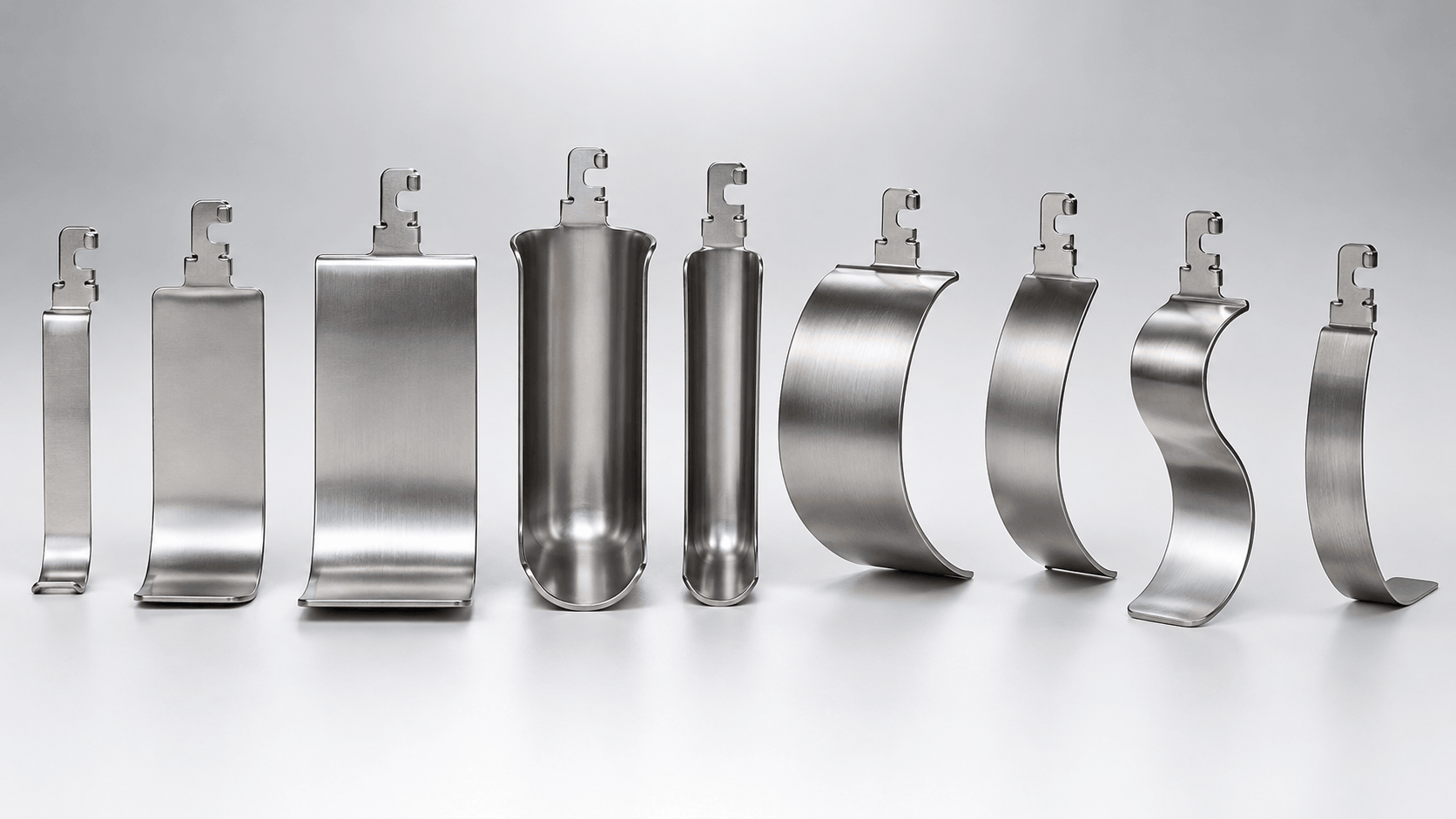
One of the most distinctive features of the Bookwalter system is the wide variety of blades in different shapes and sizes. They provide the necessary exposure in any given clinical situation. Blades of different widths, thicknesses, working surfaces, and curvature are available. Among the most popular are deep, narrow, wide, malleable, and angled blades.
4. Blade Holders and Clamps
The blades are attached to the ring by blade holders. They can be ratcheting, swivel, screw-type, and others. The most important advantage of a high-quality blade holder is its ability to withstand tissue tension without slipping.
5. Extension Arms and Attachments
Some retractor sets include additional accessories such as extension arms, extra clamps, and special attachments. These components can increase the working range of the retractor and allow more precise adaptation to the needs of the surgical site.
6. Sterilization Tray or Case
A high-quality surgical retractor comes with a special tray or case for storing and transporting the instruments. The tray also facilitates sterilization by allowing all components to be autoclaved together. If you need a complete tray with your own configuration, see our custom surgical instrument sets.
7 Amazing Facts You Must Know About the Bookwalter Surgical Retractor
The popularity of the Bookwalter surgical retractor among clinicians is due to several important advantages. Here are seven facts every medical professional should know.
Fact 1: It Minimizes the Need for Manual Retractors
Using the Bookwalter surgical retractor eliminates the need for assistants to hold hand-held retractors throughout the procedure. This reduces the burden on the surgical team and improves the efficiency of the entire operation.
Fact 2: Blades Are Completely Interchangeable and Adjustable
Each blade can be individually adapted to the demands of the situation. Clinicians can combine narrow and wide blades, straight and angled ones, and blades with different working surfaces and depths of penetration.
Fact 3: It Offers a Stable Table-Mounted Platform
Unlike hand-held retractors, the Bookwalter retractor offers a reliable solution that minimizes movement of the exposure field. This is especially important in long and demanding surgical procedures.
Fact 4: It Provides Excellent Exposure of Restricted Surgical Sites
In patients with a deep abdominal cavity or in particularly demanding surgical situations, standard retractors often offer insufficient exposure. Thanks to its design, the Bookwalter system makes it possible to achieve the necessary visualization even in restricted surgical sites.
Fact 5: The Retractor Has a Variety of Uses
The Bookwalter surgical retractor is used not only in abdominal surgeries but also in pelvic, retroperitoneal, hepatic, and other types of procedures.
Fact 6: The Quality of Steel Plays a Major Role in Performance
During its service life, the retractor goes through multiple cycles of sterilization and decontamination. The material it is made from is therefore of utmost importance. A high-quality surgical retractor should be made of medical-grade stainless steel to resist repeated sterilization and avoid premature wear. To understand the grades in detail, read our guide on stainless steel surgical instruments or our page on materials and stainless steel.
Fact 7: The Right Care Increases the Service Life of the Retractor
Proper maintenance extends the service life of the retractor and ensures the safety and efficiency of future procedures. Following recommended maintenance and care practices helps prevent mechanical failures and other problems.
Types of Bookwalter Retractor Blades
Thanks to a wide range of accessories, the Bookwalter retractor is a highly versatile device. The most common types of blades are:
Standard Flat Blades
They are primarily used to hold back the abdominal wall and soft tissues. Flat blades come in a variety of sizes that allow for a wide range of exposure adjustments.
Deep Blades
These blades have a greater working surface and are mainly used when the surgical site is located far from the incision.
Narrow Blades
Narrow blades are used primarily in narrow incisions and surgical fields.
Wide Blades
Wide blades offer a greater working surface area and are mostly used in large-volume retraction.
Curved and Angled Blades
Curved and angled blades are mainly used in surgeries where a particular anatomical structure must be exposed. Thanks to their design, they minimize displacement of tissues and organs.
Malleable Blades
Malleable blades are used in surgeries where a difficult-to-reach anatomical site must be exposed. They can be bent by hand several times to fit a particular anatomical structure.
Blades With Teeth or Smooth Edges
Depending on the desired effect and the type of tissue to be retracted, clinicians can choose blades with different surfaces. Some blades have teeth that hold the tissue in place, while others have a smooth surface to avoid traumatizing the tissue.
Surgical Applications of the Bookwalter Surgical Retractor
The Bookwalter surgical retractor is primarily used in abdominal and pelvic surgeries, including:
General Surgery
The retractor is commonly used in open abdominal surgeries, including hernia repair for large hernias, bowel resection, and exploratory laparotomy. For other tools used in these operations, see our general surgical instruments.
Colorectal Surgery
Colorectal procedures mostly involve complex dissections in the deep pelvis, which are challenging to expose with hand-held retractors. The Bookwalter retractor provides a stable platform to expose the lower abdomen and pelvic cavity.
Hepatobiliary and Pancreatic Surgery
Surgeries involving the liver, bile ducts, and pancreas mostly require wide exposure of the upper abdomen. This is achieved most effectively with wide and malleable blades.
Gynecologic Surgery
The retractor is often used in open abdominal hysterectomy and other gynecologic procedures.
Urologic Surgery
The retractor is commonly used in open urologic procedures, including cystectomy and prostatectomy.
Vascular and Retroperitoneal Surgery
Vascular and retroperitoneal surgeries involving the abdominal aorta can benefit greatly from a table-mounted retractor.
Bariatric Surgery
The retractor is an invaluable tool in bariatric surgery, since it overcomes the difficulties of manipulating hand-held retractors in patients with a thick abdominal wall.
Advantages and Limitations
Advantages
- Hands-free exposure to reduce assistant fatigue
- Highly adjustable blade positions and angles
- Stable field of view
- Modular design for versatile use in different patients and procedures
- Durable and reusable if made of good stainless steel
- Applicable in a range of specialties
Limitations
- Longer setup than simple self-retaining retractors
- Steeper learning curve for new users
- Higher cost than simpler self-retaining retractors
- Risk of blade pressure on tissues if left in place for long periods, so the surgical team should periodically release tension
- Storage space needed for the components
A competent surgical team will balance these considerations, using the appropriate blades and avoiding excessive pressure on relevant tissues.
Bookwalter vs Other Retractors
The choice of retractor depends on the type of procedure. This table compares the Bookwalter with other surgical retractors.
| Feature | Bookwalter | Balfour | Omni-Tract | Thompson |
|---|---|---|---|---|
| Design | Ring with table post | Frame with side and center blades | Table-mounted bar system | Table-mounted frame system |
| Mounting | Fixed to table | Rests on patient | Fixed to table | Fixed to table |
| Blade variety | Very wide | Limited | Wide | Wide |
| Best for | Deep abdominal/pelvic surgery | Simple laparotomy | Upper abdominal and complex exposure | Complex abdominal work |
| Setup time | Longer | Short | Moderate | Moderate |
The Balfour retractor is simple and quick to use, ideal for a standard laparotomy. The Bookwalter system has a more comprehensive, though more complex, design that is useful for deep or complicated procedures. Table-mounted systems allow versatile exposure, and the choice between them is often based on institutional preference.
How to Choose the Best Bookwalter Surgical Retractor
A Bookwalter system is a long-term investment. Consider the following points carefully before buying.
1. Material Quality
Ask the manufacturer about corrosion resistance, durability, and compatibility with autoclaving. Purchase sets made from medical-grade stainless steel that resists rust, oxidation, and repeated cleaning cycles.
2. Finish and Surface
A smooth or matte surface resists dirt, bacteria, and adhesion of organic fluids, and is easier to clean.
3. Locking Mechanism
Test the ratchets and clamps. They must allow easy but secure positioning of the blade and should not slip under tension.
4. Completeness of Set
Make sure the blade range, ring sizes, and accessories are adequate for your needs. A small set with few blades may need frequent replacements.
5. Compatibility
If your institution already owns a Bookwalter system, make sure components from your existing set fit the new system. Some manufacturers have proprietary systems that are not compatible with other suppliers’ equipment.
6. Sterilization
Make sure the instruments are compatible with the standard sterilization procedures in your facility (for example, steam autoclaving). Ask for the recommended temperature and cycle.
7. Manufacturer Reputation and Certification
Choose a supplier known for quality medical devices and ask for relevant certification (for example, CE marking and ISO 13485, the international quality management standard for medical device manufacturers) and warranty. Our buyer’s checklist for CE marked, ISO 13485 certified manufacturers explains what to ask for, and you can see how we test every batch on our quality control and inspection page.
8. Ergonomics and Weight
Avoid sets with unnecessarily heavy instruments. Such systems are slower to set up and place extra strain on the nursing staff.
9. Cost and Value
Price is always important, but a cheaper set made from lower-quality stainless steel or with an inferior finish will have a shorter lifespan. Sets with a higher purchase price but a longer warranty may offer better value in the long term. If you are buying in volume, check our bulk order and wholesale surgical instruments options.
7 Common Mistakes When Buying a Bookwalter Surgical Retractor
- Not considering value for money. Sets made from low-quality stainless steel will corrode and fail after a relatively short period of use.
- Not looking for relevant certifications. Equipment bought without the appropriate certifications may not withstand autoclaving or may fail early.
- Inadequate set contents. Make sure the ring size and blade options are sufficient for your needs.
- Incompatibility with existing systems. Some manufacturers sell systems that are not compatible with each other.
- Poor locking mechanism. The ratcheting system is crucial to the safe use of a Bookwalter retractor. Avoid sets with a faulty mechanism.
- Not considering maintenance requirements. Some systems are more difficult to clean and maintain than others.
- Not requesting samples or documentation. Always ask for product documentation and, where possible, test a sample before purchasing a full set. See our sample policy for how this works with us.
Cleaning, Sterilization, and Maintenance
Proper cleaning and upkeep will maximize the working life of your Bookwalter retractor and help ensure patient safety. Always follow the manufacturer’s recommendations, and for hospital-level protocols refer to the CDC Guideline for Disinfection and Sterilization in Healthcare Facilities. Use the general guidelines below as a starting point.
Right after use. Remove any blood or tissue debris as soon as possible. Leaving fluid on the instruments makes cleaning much harder and may damage delicate surfaces.
Disassemble. Take the system apart completely so that all surfaces can be cleaned.
Clean. Use a neutral pH enzymatic or medical detergent. Avoid acids, alkalis, or bleach solutions that may damage the steel. Use soft brushes on joints, ratchets, and other hard-to-reach places. Do not use steel wool or abrasive cleaning pads.
Rinse and dry. Remove all liquid, particularly from internal joints, to prevent staining and corrosion.
Lubricate. Apply a water-soluble instrument lubricant to joints and ratchets so they keep working smoothly.
Inspect. Before packing the instruments for sterilization, inspect every part. Look for cracks, blade warping or damage, faulty joints, worn ratchets, rust spots, or other defects. Remove any defective instruments before sterilization.
Sterilize. Pack the cleaned instruments in the appropriate pack or tray and sterilize according to the manufacturer’s instructions (usually steam autoclaving).
Troubleshooting Guide for Common Issues
| Problem | Possible cause | Solution |
|---|---|---|
| Slipping blades during surgery | Worn ratchet or faulty blade holder | Replace the blade holder or ratchet mechanism |
| Stiff or jammed movements | Lack of lubrication or dirt in joints | Clean and lubricate thoroughly |
| Corrosion spots | Left in damp conditions | Make sure instruments are completely dry after cleaning |
| Wobbling post | Poorly secured clamp | Tighten the clamp or replace it if necessary |
| Fitting issues | Using components from different manufacturers | Use a complete set of compatible components |
| Discoloration | Calcium or detergent deposits | Use appropriate water temperature and rinse solution |
Storage and Handling Guidelines
A few general guidelines will help you get the best value from your surgical retractor set.
| Tip | Description |
|---|---|
| Store in a dry place | Wet conditions encourage corrosion and joint stiffness. |
| Use the original tray or case | Keeps instruments organized and accessible while minimizing the risk of damage. |
| Do not place heavy objects on top | Avoids damaging delicate blades and other components. |
| Avoid damaging blades | Careful handling prolongs the working life of all components. |
| Use a stock list | A list of all instruments in the set makes it easier to check for missing components. |
| Train new staff | New team members should know proper storage and handling procedures. |
Frequently Asked Questions
What is a Bookwalter surgical retractor used for?
It is used to provide retraction of tissue and organs during open abdominal, pelvic, and retroperitoneal surgery.
Is the Bookwalter retractor reusable?
Bookwalter retractors made from stainless steel can be used many times if cleaned and sterilized appropriately between uses. Some disposable blades or components may also be available, depending on the manufacturer.
What is the difference between a Bookwalter and a Balfour retractor?
A Balfour retractor is a simpler self-retaining retractor with two side blades and a single center blade. A Bookwalter retractor is a table-mounted ring system with a range of interchangeable blades for more versatile exposure.
Can blades be changed during surgery?
Yes. A Bookwalter retractor’s blades can be replaced or repositioned during the procedure.
What materials are Bookwalter retractors made from?
High-quality sets are usually made from medical-grade stainless steel. Other materials may be used for specific parts or blades, depending on the design.
How do I know if a Bookwalter retractor set is good quality?
Check the quality of the steel, the finish, the locking mechanism, and whether the set is complete. It is also a good idea to request a sample test before buying.
Is the Bookwalter retractor suitable for all patients?
The retractor is appropriate for most open surgical procedures, but the choice of ring size and blades depends on the patient’s build, the procedure, and the planned incision. The surgical team will choose the most appropriate equipment for the individual case.
How long does a Bookwalter retractor last?
With proper maintenance, a good quality set can last for many years. Its working life depends on the quality of the steel, the frequency of use, and the conditions of storage.
What certifications should I look for?
Look for the CE marking and the ISO 13485 standard where applicable. These certifications are required for a medical device to be sold within the EU and indicate a high level of manufacturing quality.
Can I buy individual blades or replacement parts?
Yes, many manufacturers sell blades, holders, and rings separately. Always make sure you are buying compatible parts.
Conclusion
The Bookwalter surgical retractor continues to be one of the most reliable options for open abdominal and pelvic surgery. Its stable but versatile design allows excellent exposure while reducing the burden on the surgical team.
When choosing a system, focus on the quality of materials, ease of use, and the range of accessories. After purchase, following the appropriate maintenance and storage guidelines will prolong the working life of your equipment.
If you are looking to purchase a high-quality set, contact OrthoGear Surgical today and ask for a quote. We can help you choose the right equipment for your practice, and we also offer OEM manufacturing and private label surgical instruments for brands and distributors. You can learn more about us before you decide.