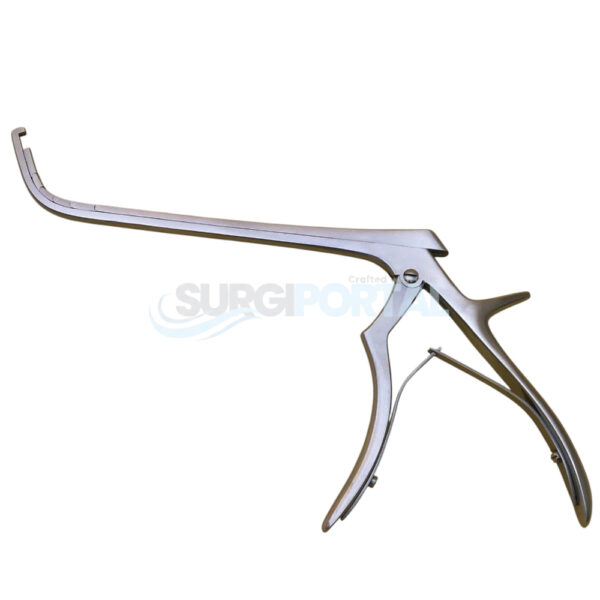
The Maxillary Seeker And Rotatable Back-Biting Endoscopic Sinus ENT Fess Instruments is a specialized instrument designed for ENT surgeons performing endoscopic sinus and maxillary sinus procedures. Its combination of a seeker-style working end and rotatable back-biting mechanism provides versatility for accessing, probing, and manipulating structures within the confined sinonasal surgical field.
The maxillary seeker configuration is intended to assist with controlled identification and exploration of anatomical pathways and openings during applicable endoscopic sinus procedures. Its precise working profile allows the surgeon to perform delicate probing and manipulation while maintaining control through the instrument handle.
The rotatable back-biting mechanism adds functional versatility by allowing the working end to be positioned according to the surgical approach. This can be particularly useful when working around angled or difficult-to-access areas of the sinonasal anatomy. The rotating feature helps facilitate instrument positioning without requiring unnecessary repositioning of the entire instrument.
Designed for FESS and related ENT procedures, the instrument is suitable for professional use in otolaryngology and rhinology settings. Its specialized configuration can support procedures involving the maxillary sinus and other selected areas of the nasal and paranasal sinus anatomy, depending on the surgeon’s technique and the specific instrument design.
The instrument is designed for precise surgical control, allowing gradual and deliberate manipulation within narrow operative spaces. Its ergonomic handle supports controlled operation during endoscopic procedures, while the specialized distal working mechanism provides access to areas that may be difficult to approach with conventional straight instruments.
The Maxillary Seeker and Rotatable Back-Biting Instrument can be a valuable addition to FESS instrument sets, ENT surgical trays, rhinology equipment, and specialized endoscopic sinus surgery collections.
For reusable instruments, cleaning, inspection, maintenance, and sterilization should be performed according to validated manufacturer instructions and established healthcare facility protocols. The working mechanism should be checked before use to ensure smooth rotation and proper function.
Key Features
- Specialized ENT endoscopic sinus instrument
- Designed for FESS and rhinology procedures
- Maxillary seeker-style working end
- Rotatable back-biting mechanism
- Supports controlled probing and manipulation
- Useful for confined sinonasal anatomy
- Adjustable working orientation through rotation
- Designed for precision endoscopic handling
- Suitable for maxillary sinus procedures
- Ergonomic design for controlled surgical operation
- Suitable for professional ENT surgical use
- Reusable when supplied as a reusable instrument
Product Specifications
| Specification |
Details |
| Product Type |
Maxillary Seeker & Back-Biting Instrument |
| Specialty |
ENT / Rhinology |
| Primary Application |
FESS / Endoscopic Sinus Surgery |
| Working End |
Maxillary Seeker & Back-Biting |
| Mechanism |
Rotatable |
| Function |
Probing, Access & Tissue Manipulation |
| Surgical Field |
Nasal & Paranasal Sinus Anatomy |
| Instrument Type |
Endoscopic ENT Instrument |
| Reusable |
Yes, when supplied as a reusable instrument |
FAQs
1. What is the Maxillary Seeker and Back-Biting Instrument used for?
It is designed for controlled probing, access, and manipulation during applicable endoscopic sinus and ENT procedures.
2. What is FESS?
FESS stands for Functional Endoscopic Sinus Surgery, a minimally invasive approach used to treat selected conditions involving the nasal and paranasal sinuses.
3. What is the purpose of the maxillary seeker tip?
The seeker-style tip can assist with controlled exploration and identification of anatomical pathways or openings during sinus surgery.
4. What does the rotatable back-biting feature do?
The rotatable mechanism allows the working end to be positioned at different orientations, helping facilitate access to angled or difficult-to-reach areas.
5. Is this instrument suitable for maxillary sinus procedures?
Yes, its configuration is specifically intended for applicable maxillary sinus and endoscopic sinus procedures.
6. Can it be included in a FESS instrument set?
Yes. Its specialized design makes it suitable for inclusion in professional FESS and ENT surgical instrument sets.
7. How should a reusable instrument be sterilized?
Reusable instruments should be cleaned, inspected, packaged, and sterilized according to validated manufacturer instructions and healthcare facility protocols.