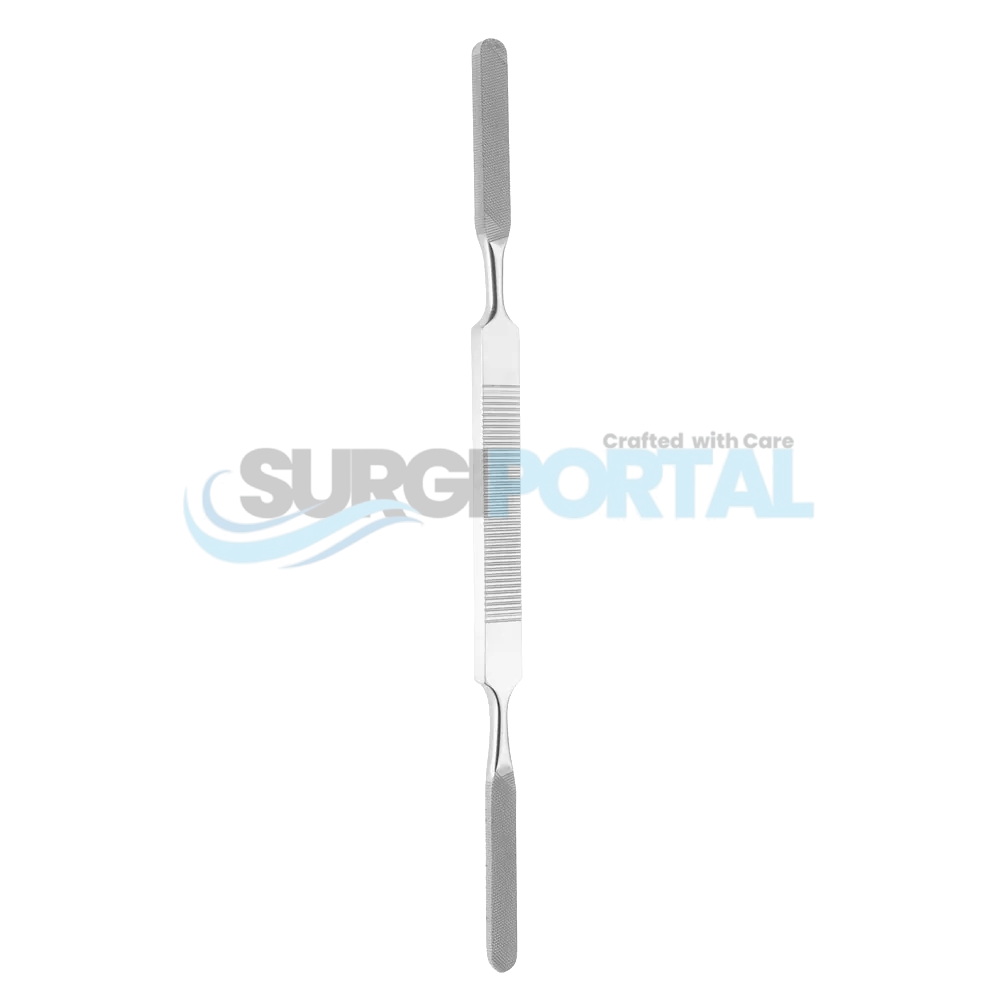
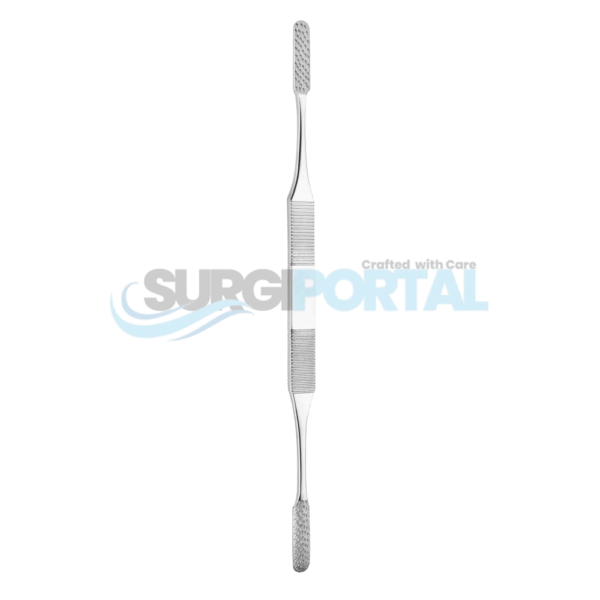
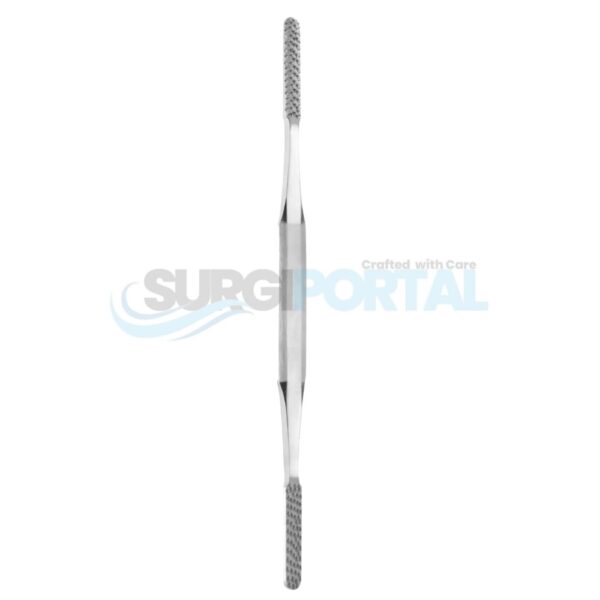
The Kleinert Kutz Rasp Fine Teeth, Flat, Double Ended, Convex is a precision surgical bone rasp designed for controlled smoothing, shaping, and refinement of bone surfaces. Its double-ended construction combines flat and convex working profiles, providing flexibility when different surface contours or approaches are required during an appropriate surgical procedure.
The fine-tooth configuration is intended for controlled surface refinement rather than aggressive initial bone reduction. It allows the user to progressively smooth irregularities and refine bone contours with measured manual strokes. This makes the rasp useful during finishing stages where gradual and controlled bone modification is preferred.
The flat working profile can provide a broad contact surface for relatively even areas, while the convex configuration is suited to working around curved or contoured surfaces. Having both configurations available on a single instrument can reduce the need to change instruments when transitioning between different bone surfaces.
The double-ended design also provides practical versatility within a surgical instrument set. The user can select the appropriate working end according to the shape and location of the bone surface being addressed. Manual operation allows the surgeon or trained professional to control pressure, direction, and stroke length according to the requirements of the procedure.
The Kleinert Kutz Rasp can be incorporated into appropriate orthopedic, reconstructive, hand surgery, and other surgical instrument collections where controlled bone contouring and surface refinement are required. The exact application should be determined by the qualified professional based on the surgical technique and anatomical requirements.
The fine teeth should be carefully maintained to preserve the intended working surface. Before and after use, the instrument should be inspected for cleanliness, deformation, damage, or excessive wear. Particular attention should be given to the fine-toothed areas during cleaning to ensure that residual biological material is removed.
When supplied as a reusable surgical instrument, cleaning, disinfection, and sterilization should be performed according to the manufacturer’s validated instructions and the healthcare facility’s established instrument-processing protocol. After processing, the rasp should be completely dried and stored appropriately to protect its working surfaces.
The Kleinert Kutz Rasp Fine Teeth, Flat, Double Ended, Convex offers a versatile combination of fine-toothed working surfaces and two distinct profiles in one surgical instrument. Its flat and convex configurations make it a practical choice for controlled bone smoothing and contour refinement in professional surgical environments.
Key Features
- Kleinert Kutz rasp design
- Fine-tooth working surfaces
- Double-ended configuration
- Flat working profile
- Convex working profile
- Designed for controlled bone smoothing
- Suitable for bone shaping and contour refinement
- Supports gradual surface refinement
- Provides two working profiles in one instrument
- Allows precise manual control
- Suitable for appropriate orthopedic and reconstructive procedures
- Reusable when supplied in a reusable configuration
Product Specifications
| Specification |
Details |
| Product Name |
Kleinert Kutz Rasp Fine Teeth, Flat, Double Ended, Convex |
| Instrument Type |
Surgical Bone Rasp |
| Design |
Kleinert Kutz Rasp |
| Teeth |
Fine |
| Configuration |
Double Ended |
| Working Profiles |
Flat and Convex |
| Primary Function |
Bone smoothing, shaping, and contour refinement |
| Working Action |
Fine manual rasping |
| Operation |
Manual |
| Applications |
Orthopedic, reconstructive, and appropriate surgical procedures |
| Reusable |
Depending on supplied configuration |
| Sterilization |
According to validated manufacturer instructions |
| Intended Use |
Professional surgical use |
FAQs
1. What is the Kleinert Kutz Rasp used for?
It is designed for controlled bone smoothing, shaping, contouring, and surface refinement during appropriate surgical procedures.
2. What does double-ended mean?
The rasp has two working ends, allowing the user to select between different working profiles without immediately changing instruments.
3. What are the flat and convex profiles used for?
The flat profile provides a broader contact surface, while the convex profile can be used for appropriately contoured or curved bone surfaces.
4. What does “Fine Teeth” mean?
Fine teeth provide a more gradual rasping action suitable for controlled surface refinement and finishing.
5. Can this rasp be used in orthopedic surgery?
Yes. It can be incorporated into appropriate orthopedic and reconstructive procedures requiring controlled bone contouring.
6. Is the Kleinert Kutz Rasp reusable?
It may be reusable when supplied as a reusable surgical instrument. Cleaning and sterilization should follow the manufacturer’s validated instructions.
7. How should the fine teeth be maintained?
The working teeth should be thoroughly cleaned and inspected after use to remove retained material and identify any signs of damage or wear.
8. Who should use this surgical rasp?
It is intended for appropriately trained healthcare professionals using it as part of suitable surgical procedures.