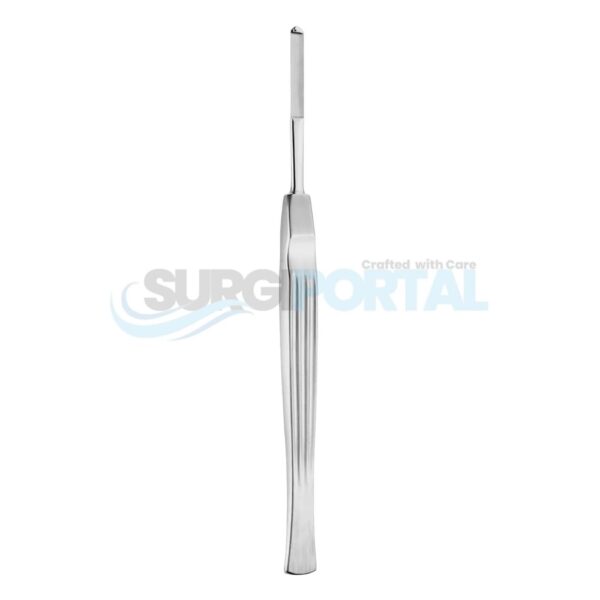
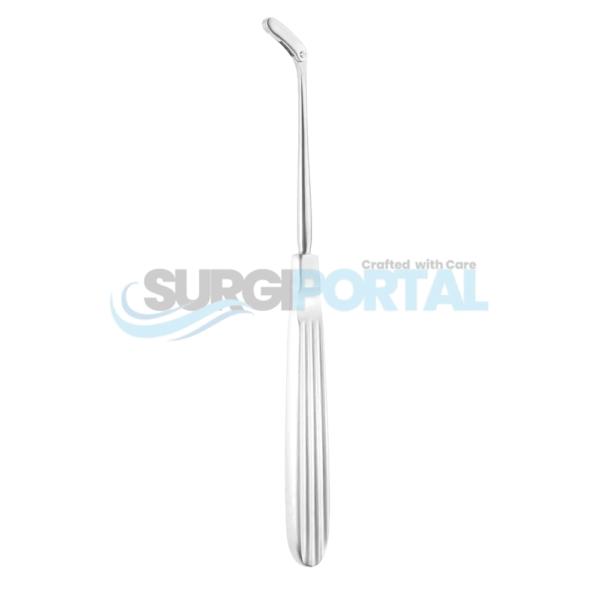
The Joseph Button End Knife Angled is a specialized surgical cutting instrument designed for controlled tissue incision and dissection during ENT and other delicate surgical procedures. Its angled profile provides a practical working orientation for accessing anatomical areas where a straight knife may be less convenient, while the button end contributes to controlled instrument positioning.
Button-end surgical knives are designed with a rounded or button-style terminal configuration that can provide a distinct working profile during tissue preparation. The Joseph pattern is commonly associated with specialized ENT and nasal surgical instrumentation, making this instrument suitable for professional otolaryngology instrument sets and selected procedures requiring controlled cutting.
The angled design is particularly useful when the surgeon needs to approach tissue from a specific direction. Angulation can improve access and positioning within confined operative fields while allowing the handle to remain in a comfortable orientation. This can be beneficial during procedures involving the nasal cavity and other anatomically restricted areas.
The Joseph Button End Knife can be used for carefully controlled tissue cutting and dissection according to the surgical technique and procedure. Potential applications include selected ENT, nasal, and reconstructive procedures where a specialized angled knife is appropriate. The exact use should always be determined by the qualified healthcare professional based on the patient’s anatomy and the requirements of the procedure.
The instrument is designed for precise manual handling. A properly balanced surgical knife allows the user to maintain control during delicate cutting movements, helping support accurate tissue preparation. The angled working profile can also help provide visibility and access when working around anatomical structures.
When supplied as a reusable surgical instrument, the Joseph Button End Knife Angled is commonly manufactured from durable surgical-instrument material suitable for professional clinical environments. A smooth, properly finished surface supports routine cleaning, inspection, and maintenance. Exact material specifications can vary according to the manufacturer and supplied configuration.
Proper reprocessing is important for maintaining the instrument’s condition and performance. After use, the instrument should be cleaned promptly according to the healthcare facility’s validated cleaning procedure. Tissue and biological residue should be removed from the working end before sterilization. The instrument should then be inspected for damage, corrosion, deformation, or other conditions that could affect safe use.
If the supplied model is reusable and validated for steam sterilization, it may be processed in an autoclave according to the manufacturer’s instructions and the healthcare facility’s approved sterilization protocol. Sterilization compatibility should always be confirmed for the specific instrument before processing.
The Joseph Button End Knife Angled is a practical addition to ENT, otolaryngology, nasal, and specialized surgical instrument sets. Its angled configuration, button-end design, and controlled cutting profile provide surgeons with a purpose-oriented instrument for delicate tissue preparation and dissection.
Key Features
- Joseph pattern button-end surgical knife
- Angled working configuration
- Designed for controlled tissue cutting
- Suitable for delicate tissue dissection
- Practical for confined surgical areas
- Supports precise manual instrument handling
- Commonly used in specialized ENT instrumentation
- Suitable for selected nasal surgical procedures
- Button-end profile for controlled positioning
- Durable construction when supplied as reusable
- Smooth surface supports routine cleaning and inspection
- Compatible with validated sterilization procedures when specified
Product Specifications
| Specification |
Details |
| Product Name |
Joseph Button End Knife |
| Configuration |
Angled |
| Instrument Type |
Button End Knife |
| Pattern |
Joseph |
| Primary Function |
Tissue Cutting & Dissection |
| Surgical Specialty |
ENT / Otolaryngology |
| Common Applications |
Nasal & Specialized Surgical Procedures |
| Working Profile |
Angled |
| Use |
Professional Surgical Use |
| Reusable |
Depending on supplied configuration |
| Sterilization |
According to manufacturer’s validated instructions |
| Material |
Surgical-instrument material, depending on specification |
FAQs
1. What is the Joseph Button End Knife used for?
The Joseph Button End Knife is designed for controlled tissue cutting and dissection during selected ENT, nasal, and specialized surgical procedures.
2. What is the advantage of the angled design?
The angled configuration provides a practical approach to tissue and anatomical structures in confined surgical areas while supporting controlled instrument handling.
3. What does button end mean?
Button end refers to the rounded or button-style terminal configuration of the knife, which provides a distinct working profile for controlled surgical manipulation.
4. Can this knife be used in ENT procedures?
Yes. The Joseph Button End Knife Angled is suitable for inclusion in professional ENT and otolaryngology instrument sets for appropriate surgical applications.
5. Is the Joseph Button End Knife reusable?
Reusability depends on the specific supplied configuration. Reusable versions must be cleaned, inspected, and sterilized between procedures.
6. How should the instrument be sterilized?
When supplied as a reusable instrument, it should be cleaned and sterilized according to the manufacturer’s validated instructions and the healthcare facility’s approved reprocessing protocol.
7. Why choose an angled surgical knife?
An angled knife can provide improved access and working orientation when approaching tissue in anatomically restricted or difficult-to-reach surgical areas.
8. What surgical specialties may use this instrument?
It may be used in ENT, otolaryngology, nasal, and selected reconstructive or specialized surgical procedures where its configuration is appropriate.