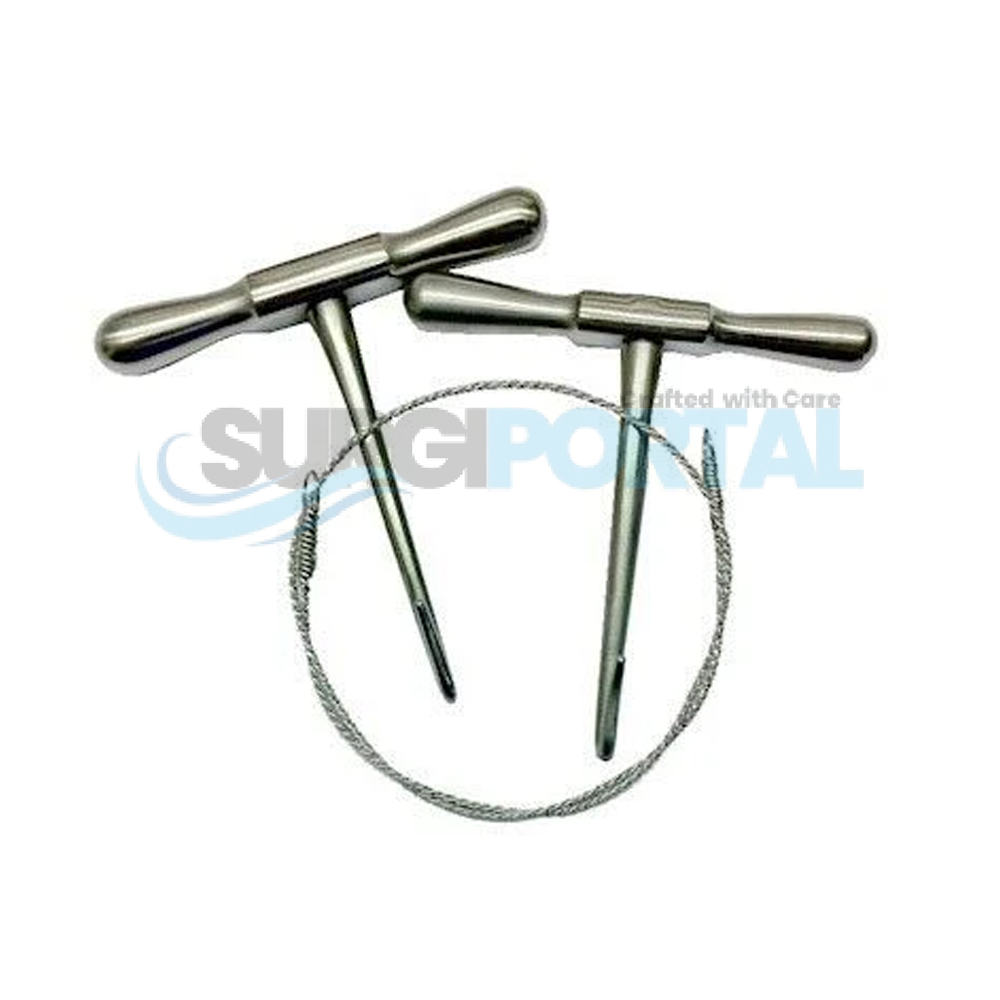
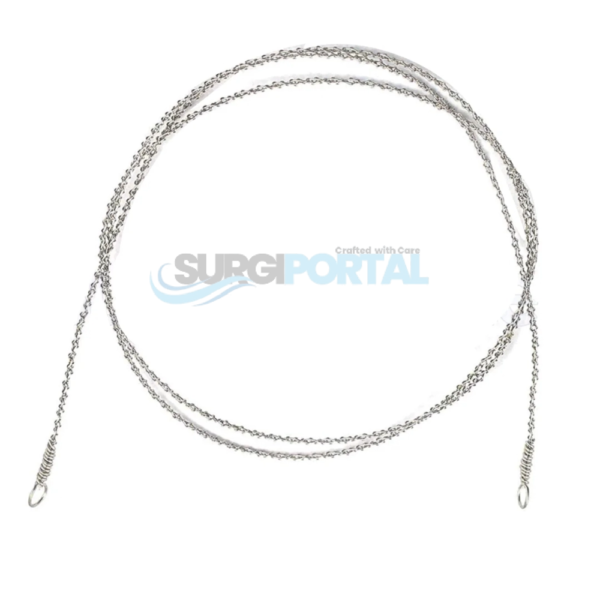
Gigli Saw with Handles is a manual bone-cutting system designed for controlled osteotomy and efficient bone sectioning during orthopedic, neurosurgical, thoracic, and maxillofacial procedures. Featuring a flexible serrated wire saw and detachable handles, this instrument system provides secure grip, precise control, and reliable cutting performance in confined or anatomically challenging surgical sites.
$110.00Original price was: $110.00.$80.00Current price is: $80.00.
Gigli Saw with Handles is a specialized surgical bone-cutting system commonly used by orthopedic surgeons, neurosurgeons, thoracic surgeons, and oral and maxillofacial surgeons during procedures requiring precise bone division.
The system consists of a flexible multi-strand wire saw with precision-engineered cutting serrations and a pair of compatible handles that attach securely to the ends of the wire. The handles provide stable traction and ergonomic control, enabling surgeons to perform smooth reciprocating movements for efficient bone cutting.
The flexible wire design allows the saw to be guided around bones and anatomical structures with the assistance of compatible Gigli saw guides or carriers. This configuration facilitates bone sectioning in deep, curved, or difficult-to-access areas where rigid saws or powered instruments may be less suitable.
The detachable handles are engineered to provide a secure grip and balanced force distribution during cutting, helping reduce hand fatigue and improve procedural accuracy.
Gigli Saw with Handles is commonly used in craniotomy procedures, orthopedic osteotomies, craniofacial surgery, thoracic interventions, pelvic procedures, trauma reconstruction, and limb amputations.
Available in multiple wire lengths, diameters, and handle designs, the system can be selected according to specific procedural requirements and surgeon preferences.
The wire saw is typically manufactured from premium surgical-grade stainless steel, while the handles are produced from durable stainless steel or lightweight medical-grade materials. Depending on the model and manufacturer, the wire saw may be supplied as a sterile single-use device or as a reusable instrument. The handles are generally reusable and autoclavable.
Widely used in hospitals, trauma centers, and surgical facilities, Gigli Saw with Handles remains an essential instrument system for manual bone-cutting procedures.
Common Clinical Applications Include:
Craniotomy Procedures
Orthopedic Osteotomies
Craniofacial Surgery
Maxillofacial Surgery
Thoracic Surgery
Pelvic Surgery
Limb Amputations
Trauma Reconstruction
Bone Grafting Procedures
Bone Sectioning
Specifications
Feature
Details
Product Name
Gigli Saw with Handles
Instrument Type
Manual Bone-Cutting System
Function
Bone Cutting and Osteotomy
Components
Flexible Wire Saw and Two Handles
Wire Design
Serrated Multi-Strand Wire
Operation
Manual Reciprocating Motion
Handle Design
Detachable Ergonomic Handles
Compatibility
Standard Gigli Saw Guides and Carriers
Material
Surgical-Grade Stainless Steel
Available Sizes
Multiple Wire Lengths and Diameters Available
Sterility
Sterile or Non-Sterile Wire Options Available*
Reusability
Single-Use or Reusable Wire Options; Reusable Handles*
Application
Orthopedic, Neurosurgical, Thoracic, and Maxillofacial Procedures
*Sterility and reusability depend on the specific model and manufacturer.
Frequently Asked Questions
What is a Gigli Saw with Handles used for?
It is used for controlled bone cutting and osteotomy procedures in orthopedic, neurosurgical, thoracic, and maxillofacial surgeries.
What is included in the system?
The system includes a flexible serrated wire saw and two compatible handles for manual operation.
How is the instrument used?
The wire saw is passed around the target bone using a guide or carrier. The handles are attached to both ends of the wire, and a reciprocating motion is used to cut through the bone.
Which procedures commonly require this instrument?
It is frequently used during craniotomies, osteotomies, amputations, thoracic procedures, craniofacial surgery, and trauma reconstruction.
Are the handles reusable?
Yes. The handles are generally reusable and designed for repeated sterilization and long-term clinical use.
Is the wire saw reusable?
Reusability depends on the specific model. Both disposable and reusable wire saw options may be available.
What material is used to manufacture the wire saw?
The wire saw is typically manufactured from surgical-grade stainless steel for flexibility, durability, and corrosion resistance.