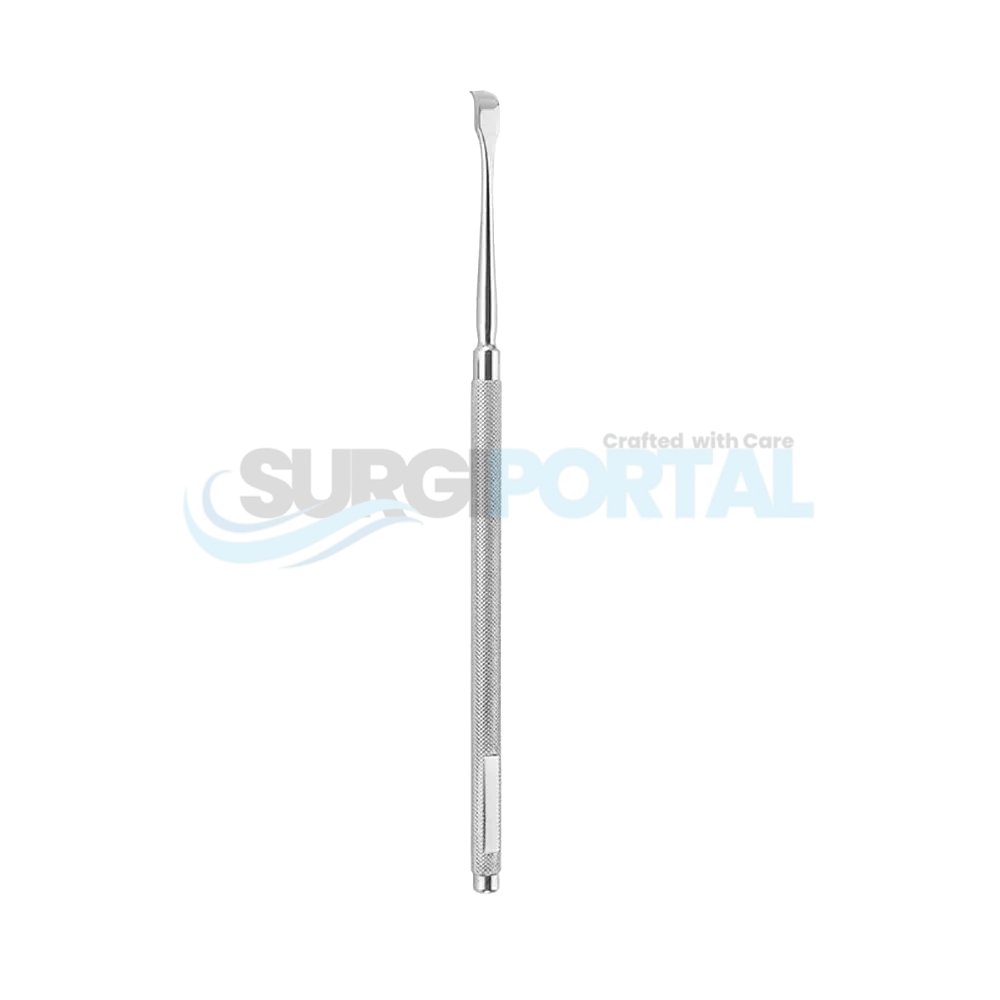
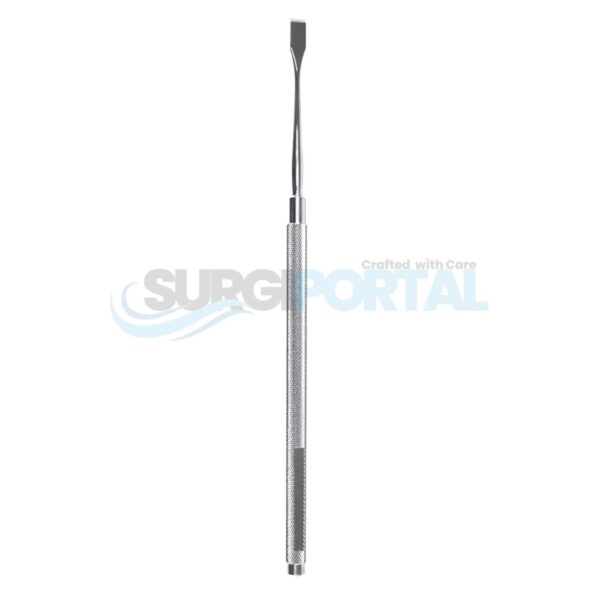
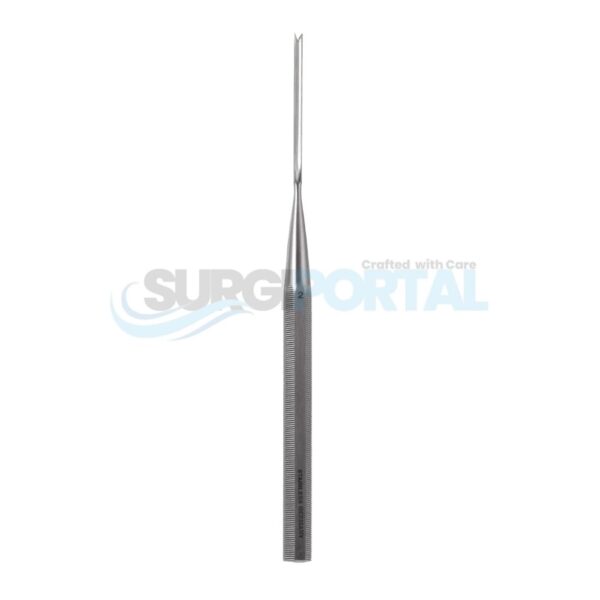
The 6 1/2″ Freer Lac Chisel Curved is a specialized surgical instrument designed for precise and controlled manipulation during delicate ENT and nasal procedures. Its curved configuration provides a distinct working angle that can assist surgeons when accessing anatomical areas where a straight chisel may be less convenient.
The Freer-style chisel is commonly associated with otolaryngology and rhinoplasty instrumentation, where controlled handling of delicate tissue, cartilage, or other anatomical structures may be required. The curved working end provides a practical approach for positioning the instrument according to the surgical site and the surgeon’s preferred technique.
With an overall length of 6 1/2 inches, this instrument offers a useful balance between reach and control. Its length allows the user to maintain a secure grip while directing the working end accurately. The curved profile can also help improve access around anatomical contours and within restricted operative areas.
The instrument may be incorporated into ENT, rhinoplasty, nasal reconstruction, and other specialized surgical sets. Exact clinical applications depend on the procedure, working-end configuration, and surgeon preference. It should be selected and used by appropriately trained healthcare professionals according to established surgical techniques.
The Freer Lac Chisel is typically manufactured from surgical-grade stainless steel to provide strength, durability, and corrosion resistance with proper care. Its smooth surface supports routine cleaning, inspection, and maintenance. If supplied as a reusable instrument, it should be thoroughly cleaned, inspected, sterilized, and maintained according to the manufacturer’s validated instructions and the healthcare facility’s applicable sterilization protocol.
The curved design makes this 6 1/2-inch Freer Lac Chisel a useful addition to specialized ENT and nasal surgery instrument collections. Its combination of controlled handling, curved access, and durable construction supports professional surgical use where precise manipulation is required.
Key Features:
- Freer-style surgical chisel design
- Overall length: 6 1/2 inches
- Curved working configuration
- Designed for controlled surgical manipulation
- Suitable for delicate ENT procedures
- Useful for nasal and rhinoplasty instrumentation
- Curved profile supports access around anatomical contours
- Provides controlled handling in confined operative areas
- Typically manufactured from surgical-grade stainless steel
- Durable construction for professional surgical use
- Suitable for specialized ENT instrument sets
- Reusable processing should follow manufacturer guidelines
Product Specifications:
| Specification |
Details |
| Product Name |
Freer Lac Chisel |
| Instrument Type |
Surgical Chisel |
| Overall Length |
6 1/2 inches |
| Configuration |
Curved |
| Specialty |
ENT / Otolaryngology |
| Common Applications |
Nasal and specialized ENT procedures |
| Working End |
Curved Chisel |
| Material |
Surgical-grade stainless steel, typically |
| Design |
Precision curved working profile |
| Reusable |
Depending on manufacturer specification |
| Sterilization |
According to validated manufacturer/facility protocol |
FAQs
1. What is a Freer Lac Chisel used for?
A Freer-style chisel is commonly used in specialized ENT and nasal procedures requiring controlled manipulation of tissue, cartilage, or anatomical structures.
2. What is the length of this Freer Lac Chisel?
This instrument measures 6 1/2 inches overall.
3. Is this Freer Chisel curved?
Yes. This model features a curved working configuration designed to support access and positioning during delicate procedures.
4. Is it suitable for rhinoplasty procedures?
Freer-style chisels may be incorporated into rhinoplasty and other nasal surgical sets. Exact use depends on the surgical technique and surgeon preference.
5. What material is the chisel typically made from?
It is typically manufactured from surgical-grade stainless steel for strength, durability, and corrosion resistance.
6. Can the Freer Lac Chisel be sterilized?
If supplied as a reusable instrument, it should be cleaned, inspected, and sterilized according to the manufacturer’s validated instructions and applicable healthcare facility protocols.
7. What is the advantage of a curved chisel design?
The curved configuration can provide a more suitable working angle for accessing anatomical contours and confined areas during specialized surgical procedures.